

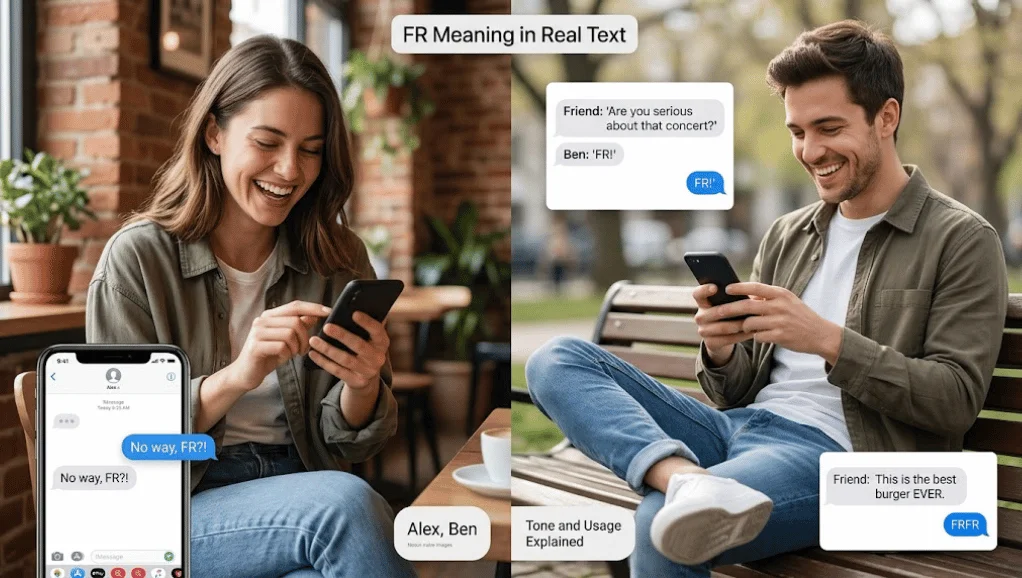
Seeing only two letters in a message can be confusing when you do not know the slang behind them. In most casual conversations, FR Meaning in Text,” and people use it to show agreement, sincerity, surprise, or emphasis. The exact tone depends on whether FR appears alone, at the end of a sentence, or with punctuation such as a question mark.
Quick answer: FR in text usually means “for real”. Someone may send “fr” by itself to strongly agree with you, or add it to a statement to show they are serious. Writing “fr?” instead asks “really?” or “are you serious?” It is informal slang commonly used in texts, chats, and social media.
| FR usage | What it usually means | Example |
|---|---|---|
| FR | For real / I agree | “That test was hard.” “FR.” |
| FR at the end | Seriously / genuinely | “I need a vacation fr.” |
| FR? | Really? / Are you serious? | “You met her?” “FR?” |
| FRFR | For real, for real / very seriously | “I’m done with that place frfr.” |
| FR + emoji | Meaning depends on the emoji and context | “That was wild fr ” |
What Does FR Mean in Text?
The most common FR meaning in text is “for real.” It is a shortened version of a familiar informal phrase used when something is genuine, true, serious, or strongly felt. In digital conversations, shortening the phrase to two letters makes it easy to use as either a quick reaction or an emphasis marker.
Someone can use FR as a complete reply when they strongly agree with another person. If a friend texts, “Monday mornings are the worst,” and you answer, “fr,” you mean “Seriously” or “Exactly.” The message is short because the conversation already supplies the rest.
FR can also emphasize the sender’s own statement instead of responding to someone else. A text such as “I’m exhausted fr” means the person is genuinely tired and wants to stress that they are not exaggerating. In this position, FR works much like “seriously,” “honestly,” or “I really mean it.”
How Does the Meaning of FR Change With Context?
Although “for real” remains the basic meaning, FR does not communicate exactly the same feeling in every message. Its position, punctuation, capitalization, emojis, and the preceding conversation can change how the reader interprets the response. That is why context matters more than trying to assign one rigid translation to every use.
Common interpretations include the following.
- Agreement: “That restaurant is overpriced.” → “FR.”
- Sincerity: “I really appreciate you fr.”
- Emphasis: “That game was difficult fr.”
- Surprise: “FR? You actually won?”
- Disbelief: “He said that fr?”
- Validation: “This semester has been exhausting.” → “Fr, I know.”
- Excitement: “We finally got tickets fr ”
- Frustration: “They canceled again fr.”
These examples all connect to the idea of something being real, serious, or genuinely felt. Surrounding words determine whether the sender agrees, emphasizes a feeling, or questions whether something actually happened. Reading the full exchange usually makes the intended meaning clear. Readers who want to build that habit of reading in context can explore MindyGest’s classroom library guide, which covers vocabulary development, comprehension, and reading fluency.
What Does “FR?” Mean in a Text?
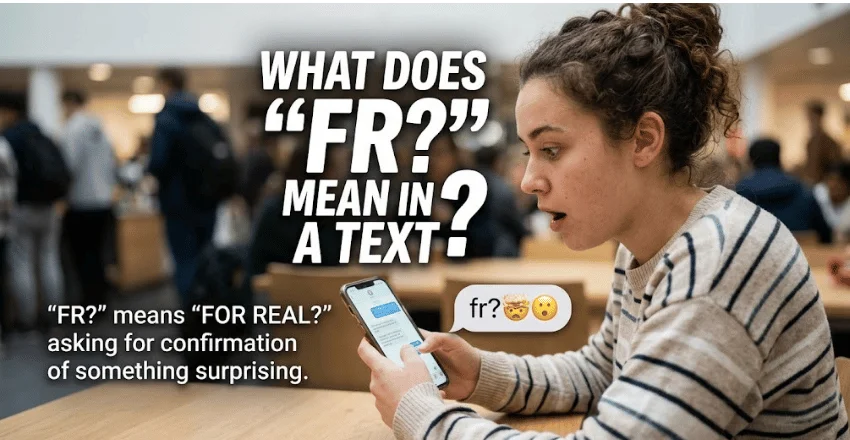
Adding a question mark changes FR from a statement into a request for confirmation. “FR?” usually means “for real?”, which can be understood as “really?” or “are you serious?” The sender is generally checking whether something surprising, unusual, or unexpected is actually true.
For example, if someone texts, “I got front-row tickets for tonight,” a reply of “fr?” shows surprise and asks whether the news is real. The sender may be excited, doubtful, or simply shocked depending on the conversation. Extra question marks, capitalization, or emojis can make that reaction appear stronger.
What Does FRFR Mean?
FRFR means “for real, for real.” Repeating the phrase adds emphasis. It usually means something closer to “I am completely serious” or “that is absolutely true.” FRFR is simply a stronger, more expressive version of regular FR.
A person might text, “I need to start saving money frfr,” when they want to stress that the statement is more than a casual thought. Another person might reply “frfr” to show especially strong agreement with a friend’s opinion. The repeated version remains informal and is most natural in relaxed digital conversation.
What Does FR Mean on Snapchat, TikTok, and Instagram?
FR generally keeps the same meaning across Snapchat, TikTok, Instagram, Discord, group chats, and ordinary text messages. People normally use it to mean “for real,” whether they are agreeing with a post, reacting to surprising information, or emphasizing a statement. The platform may influence the conversation style, but it usually doesn’t change FR’s core meaning.
A TikTok comment saying “this is me fr” usually means the viewer genuinely relates to the content. A Snapchat message saying “fr?” normally asks whether something is true, while an Instagram reply such as “fr ” may combine agreement with amusement. Emojis and surrounding comments often provide useful clues about the exact tone.
Is FR Flirty?
FR is not automatically flirty when someone sends it to you. The abbreviation mainly signals agreement, sincerity, emphasis, or surprise, so romantic meaning comes from the rest of the conversation. A person who replies “fr” after a compliment may simply be agreeing or confirming what they said rather than making a romantic advance.
For example, “You looked good tonight fr” can sound complimentary and potentially flirty because of the full sentence, not because FR itself has a romantic definition. By contrast, “That traffic was terrible fr” has no obvious romantic meaning. Look at the topic, relationship, emojis, and surrounding messages before assuming the sender is flirting.
Is Saying FR Rude?
FR is usually not rude, but it can sound casual or slightly blunt as a one-word response. Among friends, classmates, siblings, or people who regularly use internet slang, a simple “fr” often feels natural and friendly. In a serious or unfamiliar conversation, however, the same reply can seem dismissive if the other person expected a more thoughtful response.
Tone matters especially when someone is sharing personal news or asking for help. Replying only “fr” to a light complaint may show solidarity, while replying the same way to an emotional message could feel inadequate. When the situation deserves empathy or explanation, use a complete sentence rather than relying only on slang.
How Should You Reply When Someone Says FR?
The best reply depends on what FR is doing in the conversation. If the person is agreeing with you, you can simply continue the discussion, while a questioning “fr?” usually needs confirmation or more information. You don’t need to use slang yourself if it doesn’t feel natural.
| If they text | Possible reply |
|---|---|
| “FR” | “Exactly!” |
| “fr ” | “I knew you’d agree ” |
| “FR?” | “Yes, seriously.” |
| “You’re moving fr?” | “Yeah, next month.” |
| “I need a break frfr” | “Same. This week has been a lot.” |
| “That actually happened fr” | “That’s crazy.” |
You can also mirror the other person’s communication style when the relationship is casual. A short answer works well in a fast group chat, while a more complete response may be better in a personal conversation. The goal is to respond to the message’s meaning rather than feel pressured to copy every slang term the sender uses.
Can You Use FR in Professional Messages?
FR is best kept out of most formal emails, school assignments, business documents, applications, and professional communication. Because it is internet and texting slang, some readers may find it too casual or may not immediately understand what it means. Expressions such as “seriously,” “genuinely,” “I agree,” or “that is correct” are clearer alternatives in professional settings.
A relaxed team chat can be an exception when coworkers already communicate informally. Even then, consider your audience, workplace culture, and the topic’s seriousness before using slang. Clear language matters most when a message includes instructions, deadlines, clients, or information that could be misunderstood.
Where Did FR Come From?
FR developed naturally as a written shortening of “for real,” a phrase that existed long before modern texting and social media. As texting, instant messaging, and online conversations became more common, abbreviations made familiar expressions faster to type. FR eventually became a convenient way to communicate agreement, seriousness, or disbelief using only two letters.
It is difficult to identify one person, app, or exact moment that created the abbreviation. Like much online slang, it spread through everyday informal communication rather than an official definition or planned introduction. Its continued use across different apps has helped make the meaning recognizable to many people who communicate online.
Does FR Have Other Meanings?
Yes, FR can have other meanings outside casual texting, which is another reason context is important. Depending on capitalization, punctuation, or subject matter, FR may appear as an abbreviation connected with countries, languages, professional terms, or other specialized uses. In chemistry, Fr is the symbol for the element francium.
| Context | Possible meaning |
|---|---|
| Casual texting or social media | For real |
| “FR?” in a chat | For real? / Really? |
| Chemistry | Francium |
| Geographic or language abbreviation | France / French |
| Religious title written “Fr.” | Father |
| Certain specialized business contexts | Meaning may vary by industry |
If FR appears in a conversation between friends, “for real” should normally be your first interpretation. If it appears in an address, technical document, scientific discussion, form, or professional abbreviation list, another definition may make more sense. The words around the abbreviation usually resolve the ambiguity quickly.
FR vs. Similar Texting Slang
FR overlaps with several other informal expressions, but they are not completely interchangeable. Knowing the difference can help you understand the emotion behind a message instead of translating every abbreviation literally. The table below shows several common comparisons.
| Slang | Common meaning | Typical purpose |
|---|---|---|
| FR | For real | Agreement, sincerity, emphasis |
| FRFR | For real, for real | Stronger sincerity or agreement |
| NGL | Not gonna lie | Introduces an honest opinion |
| TBH | To be honest | Signals honesty or personal opinion |
| IKR | I know, right? | Strong agreement |
| ONG | On God | Strong assertion or emphasis |
| Facts | That is true | Agreement or validation |
FR is especially flexible because it can be used as a reaction, a question, or an emphasis marker within a sentence. Expressions such as NGL and TBH more commonly introduce what the speaker is about to say, while IKR typically responds to another person’s statement. Understanding these small differences makes casual online conversations easier to follow.
How to Tell What FR Means in Any Message
Start by replacing FR mentally with “for real” and see whether the sentence still makes sense. Then check the punctuation, because “fr?” usually asks for confirmation, while plain “fr” may agree or emphasize. Finally, consider the topic and relationship between the people involved.
Emojis can provide another useful clue, but don’t interpret them in isolation. “Fr ” may suggest amused agreement, “fr ” may express strong emotion or exaggerated relatability, and “fr?” may communicate straightforward surprise even without an emoji. Context remains more reliable than any single punctuation mark or symbol.
Exposure to different kinds of writing also makes unfamiliar words and expressions easier to interpret from context. Wide reading builds vocabulary, comprehension, and critical thinking, and those skills transfer directly to decoding slang. Regularly encountering language in different situations can make both traditional vocabulary and changing internet slang easier to decode.
Understanding a slang term also involves more than simply memorizing its definition. Moving from recognizing a term to explaining and applying it in context mirrors the progression described in MindyGest’s guide to Bloom’s revised taxonomy, where understanding and application build on basic recall. That distinction matters with FR because knowing it means “for real” is only the first step toward interpreting its tone correctly in a real conversation.
Frequently Asked Questions
What does FR stand for in texting?
FR most commonly stands for “for real” in texting. It can show that someone strongly agrees with a statement, genuinely means what they are saying, or wants to emphasize that something is true. The surrounding conversation determines which function is intended.
What does FR mean from a girl?
FR normally means the same thing regardless of who sends it: “for real.” A girl may use it to agree, emphasize sincerity, react with surprise, or ask for confirmation depending on the message. It does not automatically indicate romantic or flirtatious interest.
What does FR mean from a guy?
When a guy sends FR, it usually means “for real,” just as it does in other casual conversations. The message may communicate agreement, seriousness, emphasis, or disbelief depending on the wording and punctuation. Use the overall conversation, not the sender’s gender, to interpret the tone.
What does “you fr?” mean?
“You fr?” means something like “Are you for real?” “Are you serious?” or “Do you really mean that?” The sender usually asks for confirmation because something seems surprising or hard to believe. Their emotional tone may range from simple curiosity to shock or disbelief.
What does “be fr” mean?
“Be fr” is short for “be for real.” People often use it to tell someone to be serious, realistic, or honest about what they just said. Depending on the context, it can sound playful between friends or more confrontational during an argument.
Does FR mean “friend request”?
FR can occasionally represent “friend request” when the surrounding discussion is specifically about adding someone on a platform or account. In ordinary messages and social-media comments, however, “for real” is generally the more likely interpretation. Context tells you whether the message discusses a request or expresses agreement and sincerity.
Is FR the same as “seriously”?
FR can often be understood as “seriously,” but the two are not identical in every sentence. It may also mean “I agree,” “genuinely,” “really?” or “that is true,” depending on how it is used. Thinking of “for real” as the core meaning makes it easier to understand those different shades of tone.
Bottom Line
The simplest answer to FR meaning in text is “for real.” People use the abbreviation to agree strongly, emphasize sincerity, react to surprising information, or ask whether something is actually true. Variations such as “fr?” and “frfr” keep the same basic idea while changing the strength or direction of the message.
The safest way to interpret FR is to read the whole conversation instead of focusing only on the two letters. In casual texting, Snapchat messages, TikTok comments, Instagram replies, and group chats, “for real” will usually fit naturally. In technical or formal contexts, check whether FR has another specialized meaning before assuming it is slang.