

Bloom’s revised taxonomy serves as a dynamic blueprint for modern education, redefining how educators approach teaching and how students engage with learning. Unlike traditional models that focused heavily on memorization, this taxonomy emphasizes a continuum of cognitive skills, moving learners from basic knowledge acquisition to the creation of original ideas.
For educators, it offers a practical framework for designing lessons, crafting assessments, and aligning classroom activities with specific cognitive outcomes. Its adaptability across subjects, from STEM fields to humanities and the arts, ensures that learning is not only comprehensive but also relevant, engaging, and skill-oriented.
| Aspect | Details / Key Points |
| Bloom’s Revised Taxonomy | Provides a structured framework for teaching and learning; categorizes cognitive skills from basic to higher-order thinking. |
| Cognitive Levels | Remember: Recall facts and basic concepts. Understand: Explain ideas and concepts Apply: Use knowledge in practical situations. Analyze: Break down information and examine relationships Evaluate: Make judgments and justify decisions. Create: Generate original work or ideas |
| Actionable Verbs | Emphasis on measurable, observable learning objectives (e.g., describe, implement, critique, design). |
| Benefits for Students | Encourages deep learning, critical thinking, creativity, problem-solving, and engagement with material. |
| Benefits for Educators | Helps plan lessons, structure learning activities, design assessments, and measure outcomes effectively. |
| Assessment Alignment | Enables creation of assessments that test knowledge across all cognitive levels, from recall to creation. |
| Cross-Disciplinary Use | Applicable in science, literature, business, technology, arts, and virtually any educational context. |
| Overall Impact | Bridges the gap between instruction and practical application, fostering higher-order thinking and lifelong learning. |
Bloom’s Revised Taxonomy
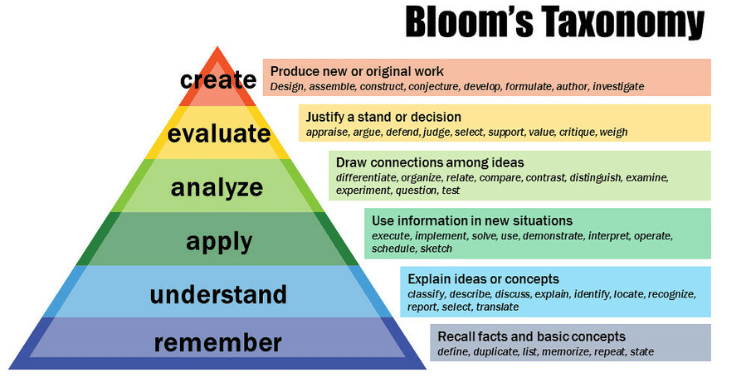
Bloom’s revised taxonomy is a modernized framework for understanding and categorizing cognitive skills in education, designed to guide both teaching and learning. Originally developed by Benjamin Bloom in 1956, the revised version, updated by Anderson and Krathwohl in 2001, redefines the hierarchy of cognitive processes to better reflect how students interact with knowledge.
Unlike the original taxonomy, which used nouns to describe learning objectives, the revised taxonomy employs actionable verbs, such as remember, understand, apply, analyze, evaluate, and create, to make learning goals more measurable and observable. This approach emphasizes progression from lower order thinking skills, like recalling facts.
The taxonomy not only helps educators design structured curricula and assessments that align with cognitive complexity but also encourages students to engage actively with content, fostering critical thinking, creativity, and problem-solving abilities. Its versatility across disciplines, from science and mathematics to literature and the arts.
Understanding of Bloom’s Taxonomy
Bloom’s Taxonomy was originally developed in 1956 by Benjamin Bloom and his colleagues to categorize educational goals and objectives into levels of complexity. It was widely used to design curricula, assessments, and teaching strategies. However, in 2001, a team led by Lorraine Anderson and David Krathwohl revised the taxonomy to better align with modern cognitive psychology and practical classroom applications.
The revised taxonomy introduced two major changes:
- Verbs instead of nouns – The original taxonomy used nouns like “Knowledge” and “Comprehension.” The revised version emphasizes cognitive actions, such as “Remember” and “Understand,” making it more actionable for lesson planning.
- Reordering the top levels – The top two levels were switched. “Evaluation” became “Evaluate,” and “Synthesis” became “Create,” highlighting the importance of generating new ideas rather than just judging existing ones.
The Six Levels of Bloom’s Revised Taxonomy
The revised taxonomy organizes cognitive skills into six hierarchical levels, each building upon the previous one. Teachers and instructional designers use these levels to structure lessons and assessments from simple recall to complex problem-solving.
1. Remember

Definition: The ability to recall facts, concepts, and basic information without necessarily understanding it.
Key Actions: Recognizing, recalling, listing, describing, naming.
Example in Education
- Memorizing vocabulary words in a language class.
- Listing the capitals of countries.
Significance: This is the foundational level that ensures learners have the basic knowledge needed for higher-order thinking.
2. Understand

Definition: The ability to comprehend and interpret information, grasp meaning, and translate knowledge into one’s own words.
Key Actions: Explaining, summarizing, paraphrasing, classifying, comparing.
Example in Education
- Summarizing a chapter in a textbook.
- Explaining the principle of photosynthesis in biology.
Significance: Understanding allows learners to internalize knowledge rather than just memorize it.
3. Apply

Definition: Using knowledge in real-world scenarios or practical situations.
Key Actions: Implementing, solving, demonstrating, executing, using.
Example in Education
- Solving mathematical problems using formulas learned in class.
- Applying grammar rules in writing exercises.
Significance: The application demonstrates that learners can transfer their knowledge into practical contexts.
4. Analyze

Definition: Breaking down information into components to understand relationships, patterns, and organizational structures.
Key Actions: Differentiating, organizing, attributing, deconstructing, comparing.
Example in Education
- Comparing themes across two novels in literature.
- Analyzing statistical data to find trends.
Significance: Analysis fosters critical thinking and helps learners identify causes, effects, and relationships.
5. Evaluate

Definition: Making judgments based on criteria, standards, or evidence. This involves assessing the value, credibility, or quality of information.
Key Actions: Critiquing, justifying, recommending, defending, prioritizing.
Example in Education
- Critiquing a research paper based on methodology and conclusions.
- Evaluating the effectiveness of a marketing strategy.
Significance: Evaluation cultivates decision-making skills and the ability to form reasoned judgments.
6. Create

Definition: Producing original work or ideas by combining knowledge, skills, and understanding. This is the highest level of cognitive processing in the revised taxonomy.
Key Actions: Designing, constructing, composing, formulating, and generating.
Example in Education
- Writing an original story or research paper.
- Designing an innovative experiment in a science class.
Significance: Creation represents innovation, creativity, and mastery of knowledge, allowing learners to contribute something new to their field.
Importance of Bloom’s Revised Taxonomy in Modern Education
Bloom’s revised taxonomy offers several key benefits that make it an essential tool in modern education. Firstly, it provides a structured learning progression, serving as a roadmap for designing curricula that move students from foundational knowledge to higher-order thinking skills. Secondly, it promotes clear learning objectives, as the use of actionable verbs allows teachers to define measurable and specific goals for each lesson.
Additionally, the taxonomy ensures assessment alignment, enabling educators to create evaluations that test students across all cognitive levels, from simple recall to creative application. By placing emphasis on analysis, evaluation, and creation, it fosters enhanced critical thinking, encouraging learners to go beyond memorization and engage in deeper cognitive processes.
Practical Applications of Bloom’s Revised Taxonomy

Curriculum Design
- Educators can structure lessons by aligning activities with each cognitive level.
- Remember: Begin with factual recall, such as defining terms or listing key concepts.
- Understand: Move to explanations, encouraging students to describe ideas in their own words.
- Apply: Conduct experiments or practical exercises to implement learned concepts.
- Analyze: Examine results, identify patterns, and explore relationships between ideas.
- Evaluate: Assess conclusions, make judgments, and justify decisions based on evidence.
- Create: Culminate with an innovative project, allowing students to design or construct something original.
Instructional Strategies
- Remember: Flashcards, quizzes, and memorization exercises.
- Understand: Discussions, concept mapping, summarizing.
- Apply: Case studies, practical labs, problem-solving exercises.
- Analyze: Compare and contrast tasks and data analysis projects.
- Evaluate: Debates, peer reviews, critique sessions.
- Create: Projects, original research, design tasks.
Assessment Design
- Teachers can design assessments that align with each cognitive level of Bloom’s Revised Taxonomy.
- Ensure students are not only memorizing facts but also demonstrating deeper understanding.
- Assess application by having students solve problems or use concepts in new situations.
- Evaluate analysis through tasks that require breaking down information and identifying relationships.
- Test evaluation by asking students to make judgments, justify decisions, or critique ideas.
- Encourage creation with projects or assignments that involve designing, constructing, or producing original work.
Benefits for Students and Educators
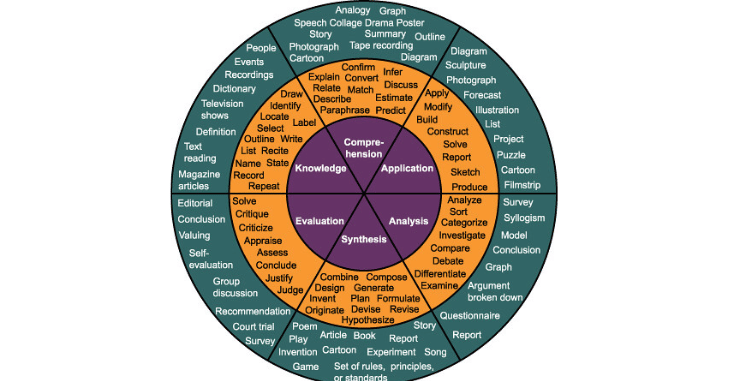
Bloom’s revised taxonomy benefits both students and educators in meaningful ways. For students, it encourages deep learning by promoting critical thinking, creativity, and stronger problem-solving skills, helping them move beyond rote memorization to truly understand and apply knowledge.
For educators, the taxonomy provides a clear and structured framework to plan lessons, align learning activities with cognitive levels, and effectively measure learning outcomes, ensuring that teaching is purposeful and that students are developing higher-order thinking skills.
Challenges and Considerations
While Bloom’s revised taxonomy is highly useful, some challenges include:
- Ensuring that learning activities actually match the intended cognitive level.
- Avoiding overemphasis on lower levels (memorization) at the expense of higher-order skills.
- Adapting the taxonomy for online and technology-based learning environments.
Conclusion
In conclusion, Bloom’s revised taxonomy has transformed the landscape of modern education by providing a structured, actionable framework that bridges foundational knowledge and higher-order thinking. By organizing cognitive skills into six progressive levels- Remember, Understand, Apply, Analyze, Evaluate, and Create- it encourages students to move beyond rote memorization and actively engage with content through critical thinking, problem-solving, and creative expression.
For educators, it offers a clear roadmap for designing curricula, aligning assessments, and structuring lessons that are both measurable and meaningful. Its adaptability across subjects, from STEM and literature to business and the arts, ensures that learning remains relevant, engaging, and skill-oriented.
If you want to read an interesting article about it, explore our Education category.
FAQs
Bloom’s revised taxonomy is a modern framework for categorizing cognitive skills in education, emphasizing actionable verbs and a progression from basic knowledge to higher-order thinking, including Remember, Understand, Apply, Analyze, Evaluate, and Create.
It helps educators design structured lessons, align assessments with learning goals, foster critical thinking, creativity, and problem-solving, and ensure students engage deeply with the content rather than just memorizing facts.
The six levels are: Remember (recall information), Understand (explain concepts), Apply (use knowledge in practice), Analyze (break down and examine), Evaluate (make judgments), and Create (generate original ideas or work).
Students gain deeper learning, creativity, and higher-order thinking skills, while educators get a clear framework to plan lessons, structure activities, and design assessments that measure learning outcomes effectively.
Yes, it is versatile and can be applied in STEM, literature, arts, business, and virtually any educational context, making it a universal tool for structured and meaningful learning.