


Your closet has money sitting in it. The hard part isn’t the listing; it’s picking the app that doesn’t quietly take a fifth of every sale. This guide gives you the current numbers from each platform’s own fee page, then walks you through getting your first item live tonight.
Quick answer: To sell clothes online, choose one marketplace, photograph each piece in daylight, price it from sold listings instead of retail, and ship within two business days. Vinted and Depop take the least from US sellers. Poshmark takes 20%, the most of the big seven, though it moves women’s fashion fast.
The key numbers at a glance
| Question | Short answer |
|---|---|
| Cheapest platform for US sellers | Vinted, which charges sellers nothing |
| Highest headline rate | Poshmark, 20% on sales over $15 |
| Free to list | All seven, though eBay caps you at 250 free listings a month |
| The least work for you | ThredUp, which photographs and prices everything |
| Payout on a $40 sweater | $6 to $40, depending where you list it |
| Time to your first payout | Days on most apps, 10 to 14 weeks on ThredUp |
TL;DR
- Vinted charges US sellers no selling fee at all, and the buyer covers shipping.
- Depop dropped its commission for US sellers, but payment processing still costs 3.3% plus $0.45.
- eBay takes 13.6% plus $0.40 on most clothing, with different rates for handbags and sneakers.
- ThredUp is the easiest route and the most expensive one. Payouts start at 3%.
- Every fee below was checked against the platform’s own 2026 fee page, not copied from blogs.
What it costs to sell clothes online in 2026

Fees change more often than most guides admit. These are the rates published by each company as of August 2026.
| Platform | Seller fee | Other seller costs | Shipping |
|---|---|---|---|
| Vinted | None | None | The buyer pays for the prepaid label |
| Depop | 0% commission for US sellers | 3.3% + $0.45 processing; 12% if you boost a listing | The buyer prepays the label |
| Facebook Marketplace | Nothing on local pickup; 5% per shipment with checkout | Flat $0.40 on shipments of $8 or less | You arrange it |
| Mercari | 10% of item price plus buyer-paid shipping | $3 for Instant Pay; direct deposit is free | Prepaid label, either side pays |
| Poshmark | $2.95 flat on sales of $15 and under, 20% above that | None | The buyer pays for the prepaid label |
| eBay | 13.6% + $0.40 per order on most clothing | $0.35 per listing past 250 a month; 15% on women’s handbags; 8% on athletic shoes priced $150 and up | You buy the label |
| ThredUp | You keep 3% to 80% of the sale price, by price tier | $34.99 for Premium; $5.99 to reclaim an unsold item | Free inbound label |
Two of those deserve a flag. Depop’s zero commission looks unbeatable until you notice the processing charge, which lands on the item price, the shipping, and any tax. And ThredUp’s tiered payout is brutal at the low end: a piece that sells for $12 earns you between $0.15 and $3.
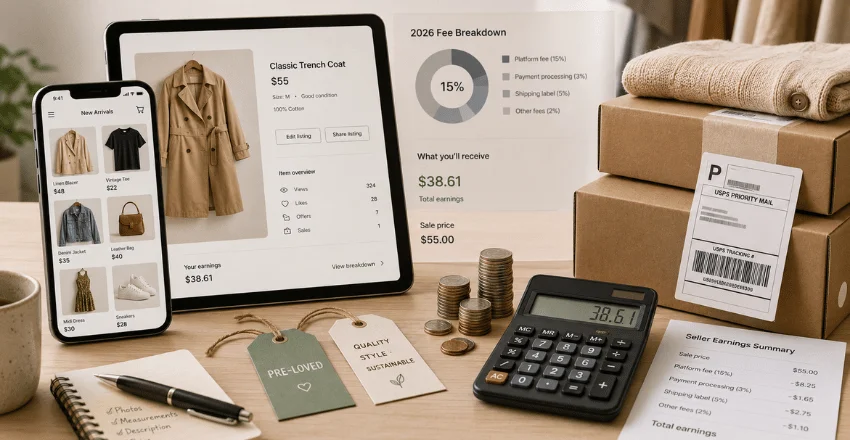
What you actually keep on a $40 sweater
Here’s the same sale run through every platform. Assume a $40 sweater, $5 of buyer-paid shipping, and no sales tax.
| Platform | Fees on the sale | You keep |
|---|---|---|
| Vinted | $0 | $40.00 |
| Facebook Marketplace, local pickup | $0 | $40.00 in cash |
| Depop | $1.94 | $38.06 |
| Facebook Marketplace, shipped | $2.00 | $38.00 before the label |
| Mercari | $4.50 | $35.50 |
| eBay | $6.52 plus a $5 label | $33.48 |
| Poshmark | $8.00 | $32.00 |
| ThredUp | 70% to 85% of the sale | $6.00 to $12.00 |
An $8 gap between the top and the bottom of that list sounds small. Multiply it by fifty items, and it’s a car payment.
What sells, what sits, and what gets turned away
Mid-price brands in current sizes move fastest. Denim, activewear, outerwear, shoes, and bags all outperform fast-fashion tops because buyers can picture the price they’d pay new. Anything with a strong resale reputation holds up best, and sturdy footwear such as leather boots that hold their value is a reliable place to start.
What sits: pilled knitwear and stretched-out basics from brands that never stop discounting.
Rejections catch people out too. ThredUp won’t take men’s clothing at all, and it turns down items without size tags, pajamas, altered pieces, and wedding dresses. It also accepts only 60% to 80% of a standard bag, and about 38% of accepted items don’t sell inside their window.
What you’ll need before you list
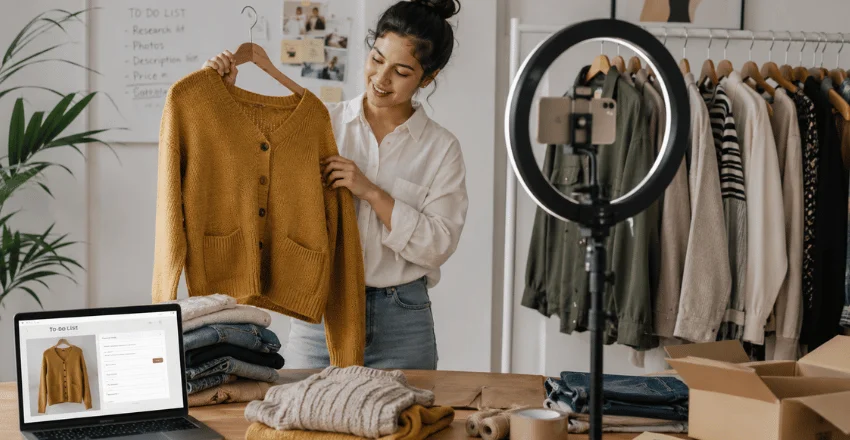
- A phone camera and a window with daylight
- Any plain wall, door, or clean sheet as a backdrop
- Tape measure for chest, waist, inseam, and hem
- A kitchen scale, so your shipping weight is honest
- Poly mailers or reused boxes and packing tape
- A bank account for payouts
That’s the whole kit. A steamer helps, but a hot shower and a hanger do the same job.
How to list your first item in eight steps
- Sort ruthlessly. Make three piles: sell, donate, recycle. If you wouldn’t buy it back at half price, it goes in pile two.
- Pick one platform. Vinted for cheap fees, Poshmark for women’s brands, eBay for menswear and vintage, and Depop for anything Y2K. Beginners usually find Mercari and Vinted the easiest first apps, since listing takes about two minutes.
- Clean and press everything. Wash it, remove lint, and hang it overnight so the creases fall out.
- Photograph the item properly. Six shots: front, back, label, fabric tag, a close-up of the texture, and an honest photo of every flaw. Daylight only. No flash.
- Measure it flat. Sizing runs wild across brands and decades, and posted measurements cut your return rate more than any other single habit.
- Write a title buyers search—brand, item, color, size, era. Levi’s 501 straight jeans, black, W29, beats “cute vintage jeans” every time.
- Price used clothing from sold listings. Filter any marketplace to completed sales and copy that range. Retail price is irrelevant. Expect offers 10% to 20% under your ask, so list slightly high.
- Ship within two business days. Slow shipping tanks your seller rating faster than a bad photo ever will.
Timing matters as much as the listing itself. Warm-weather pieces like summer tank tops sell in March and April, not in the last week of August, and coats start moving in September.
Shipping, returns, and how fast you get paid
Four of the seven hand you a prepaid label. Poshmark, Vinted, Depop, and Mercari all generate one automatically, so you print it or scan a QR code at the drop-off point. On eBay you buy the label yourself, and on Facebook Marketplace you arrange the whole thing. Packaging is always your problem, whichever app you use.
Set your return terms before you list, not after a buyer complains. It’s worth reading how big retailers word their returns and exchange policies and borrowing the plain language for your own listing.
Payouts differ more than fees do. Mercari pays by free direct deposit in about five business days, or instantly for a $3 charge. Poshmark and Vinted release funds once the buyer accepts the order, and Depop works the same way. ThredUp is the outlier: from mailing your bag to holding the money takes 10 to 14 weeks for most standard sellers.
Five mistakes that cost sellers money
- Hiding a flaw. You’ll get one sale and one return, plus a rating you can’t undo.
- Guessing the weight. Underpaid labels get charged back to you.
- Pricing from the receipt. Nobody cares what you paid.
- Listing ten items and stopping. Volume drives sales on every marketplace here.
- Ignoring offers. Reply the same day, even to lowballs
Start with five items this week
Pull five pieces you haven’t worn in a year, weigh them, shoot them by a window, and post them tonight. Choose the platform whose fees suit your price range, then reinvest the first payout in a stack of mailers. Momentum is the only real secret here.
Frequently asked questions
Vinted, for pure economics: no seller fee, buyer-paid shipping, and a listing flow you can finish on a phone in two minutes. If your closet leans toward recognizable women’s brands, Poshmark finds buyers faster, and the higher fee often pays for itself.
Selling locally through Facebook Marketplace, because a cash pickup carries no fee and no shipping. Vinted is the cheapest option that reaches a national audience.
Not at first. Learn one app, list thirty items, then cross-list your slow movers somewhere else. Managing four accounts before your first sale is how people burn out.
Popular brands in common sizes often go within a week or two. Everything else depends on price, and a 10% cut usually does more than a new photo.