

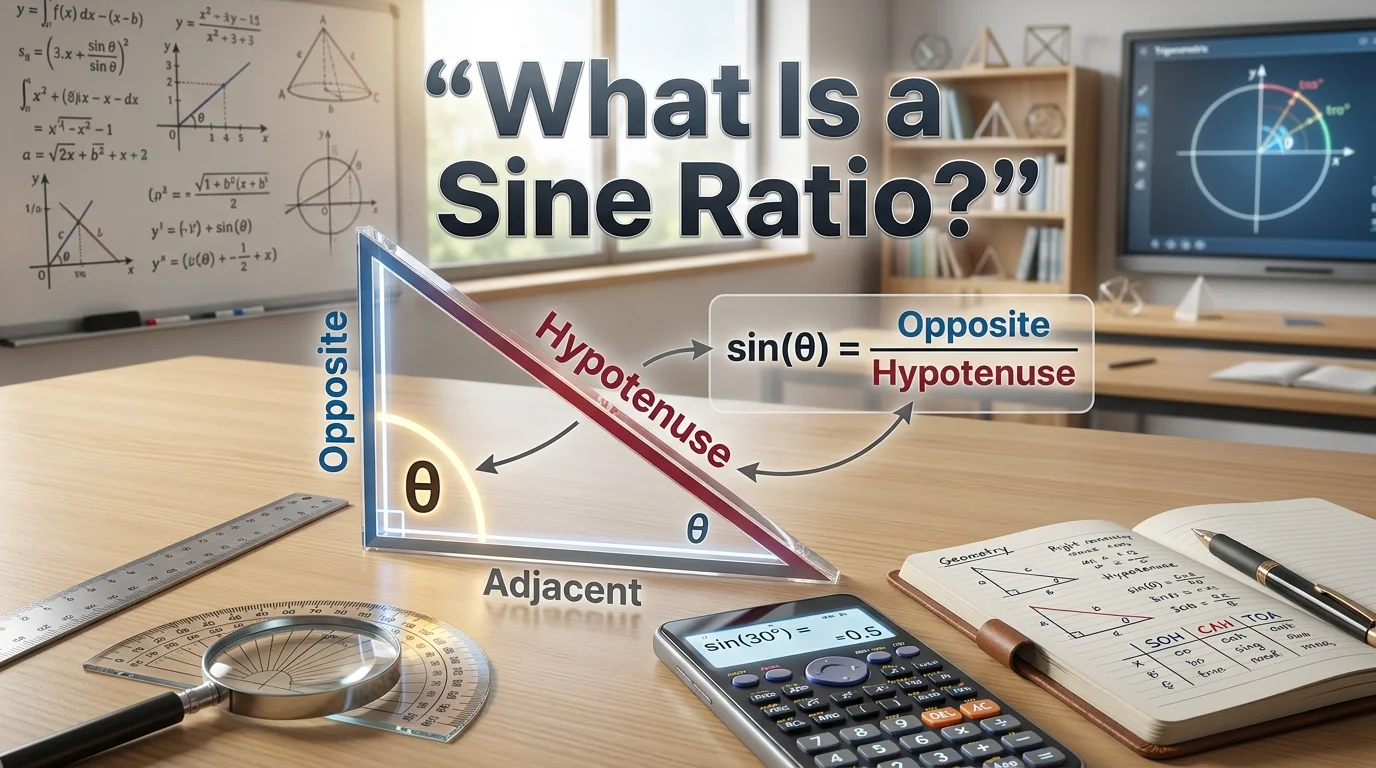
If you are learning right-triangle trigonometry, the sine ratio is one of the first relationships you need to understand. It connects an angle in a right triangle to two of the triangle’s side lengths, allowing you to calculate unknown measurements without physically measuring them. Once you know which sides are the opposite side and hypotenuse, using sine becomes much easier.
What Is a Sine Ratio? The length of the side opposite an acute angle in a right triangle divided by the length of the hypotenuse. It is written sin θ = opposite ÷ hypotenuse. Students often remember it with SOH in SOHCAHTOA. The ratio can help you find missing sides or angles when you know enough information.
What Is a Sine Ratio?
A sine ratio is a trigonometric ratio that compares the side opposite a chosen angle with the hypotenuse of a right triangle. In mathematical notation, sine is abbreviated as sin, and the selected angle is often represented by the Greek letter theta, θ. OpenStax and Khan Academy define sine in a right triangle using this same opposite-to-hypotenuse relationship.
The basic formula is:
sin θ = opposite/hypotenuse
Suppose the side opposite angle θ measures 3 units and the hypotenuse measures 5 units. The sine ratio is 3/5, which is equal to 0.6. The units cancel because sine is a ratio between two lengths measured in the same units.
Understanding the Three Sides of a Right Triangle
Before calculating sine, you need to identify the sides of the right triangle correctly. Every right triangle contains one 90-degree angle, and the hypotenuse is always the side directly across from that right angle. The names opposite and adjacent, however, depend on which acute angle you are using as your reference.
- Hypotenuse: The longest side of the right triangle and the side opposite the 90-degree angle.
- Opposite: The side directly across from the angle you are studying.
- Adjacent: The non-hypotenuse side touching the angle you are studying.
The hypotenuse never changes when you switch between the two acute angles in a right triangle. The opposite and adjacent sides do change because those labels describe each side’s position relative to your chosen angle. This distinction is important because identifying the wrong side leads to the wrong trigonometric ratio.
What Does SOH Mean in SOHCAHTOA?
Students commonly remember the sine formula through the mnemonic SOHCAHTOA. The first three letters, SOH, mean Sine = Opposite ÷ Hypotenuse, while CAH and TOA represent the cosine and tangent ratios. This mnemonic is widely used when introducing right-triangle trigonometry.
| Ratio | Formula | Mnemonic |
|---|---|---|
| Sine | opposite ÷ hypotenuse | SOH |
| Cosine | adjacent ÷ hypotenuse | CAH |
| Tangent | opposite ÷ adjacent | TOA |
SOHCAHTOA helps you choose a ratio based on the sides involved in a problem. If a question involves the opposite side and hypotenuse, sine is normally the appropriate choice. If it instead involves the adjacent side, you may need cosine or tangent.
How to Find the Sine Ratio Step by Step
Finding a sine ratio is mostly a matter of labeling the triangle correctly before doing any arithmetic. Identify the reference angle first because it tells you which side is opposite. After that, the calculation follows directly from the sine formula, and working in that order moves you from simply recalling a formula toward applying it, the learning progression described in Mindygest’s Bloom’s revised taxonomy guide.
- Find the 90-degree angle and identify the hypotenuse.
- Locate the acute angle named in the problem.
- Identify the side directly opposite that acute angle.
- Write sin θ = opposite/hypotenuse.
- Substitute the two side lengths.
- Simplify the fraction or convert it to a decimal if required.
This procedure works whenever you know the relevant opposite side and hypotenuse. If one of those sides is missing but the angle is known, the same equation can be rearranged to solve for the missing measurement. You can also use inverse sine when the two side lengths are known, and the angle itself is unknown.
Example 1: Find a Sine Ratio From Side Lengths
Imagine a right triangle with an opposite side of 7 inches and a hypotenuse of 25 inches. Substitute those measurements into the formula to get sin θ = 7/25 = 0.28. Therefore, the sine of that particular angle is 0.28.
Notice that you don’t need the adjacent side for this calculation. Sine only uses the opposite side and hypotenuse in a right-triangle problem. That makes identifying the given side pair one of the fastest ways to choose between sine, cosine, and tangent.
Example 2: Use Sine to Find a Missing Side
Suppose a right triangle has a 35-degree angle and a hypotenuse measuring 10 feet, and you want to find the side opposite the 35-degree angle. Begin with sin 35° = opposite/10, then multiply both sides by 10 to obtain opposite = 10 × sin 35°. Using a calculator, the opposite side is approximately 5.74 feet.
Make sure your calculator is operating in degree mode when the problem gives an angle in degrees. Entering a degree measurement while the calculator is set to radians can produce a completely different answer. Checking the calculator mode is therefore a useful habit before solving trigonometry problems.
Example 3: Use the Sine Ratio to Find an Angle
Sine can also help when you know the opposite side and hypotenuse but do not know the angle. For example, if the opposite side is 6 feet and the hypotenuse is 10 feet, then sin θ = 6/10 = 0.6. To recover the angle, use the inverse sine function: θ = sin⁻¹(0.6) ≈ 36.87°.
The inverse sine button may appear as sin⁻¹ or require the Shift or 2nd key on a scientific calculator. In this context, sin⁻¹ means the inverse trigonometric function used to find an angle, not simply one divided by sine. Keeping that difference in mind prevents a common calculator mistake.
Why Does the Sine Ratio Stay the Same?

If two right triangles contain the same acute angle, the triangles have the same shape even when one is much larger than the other. Their corresponding side lengths increase or decrease proportionally, so dividing the opposite side by the hypotenuse produces the same value in both triangles. This idea comes from triangle similarity and explains why trigonometric ratios work.
This principle is also reflected in U.S. Common Core high-school geometry standards. Standard HSG-SRT.C.6 asks students to understand that similarity makes right-triangle side ratios properties of their angles, leading directly to definitions of trigonometric ratios. The following standard also expects students to use those ratios when solving applied right-triangle problems.
Sine Ratio vs. Cosine and Tangent
Sine, cosine, and tangent are all trigonometric ratios, but each compares a different pair of right-triangle sides. Sine uses opposite and hypotenuse, cosine uses adjacent and hypotenuse, and tangent uses opposite and adjacent. Choosing correctly depends on which measurements the problem gives you and which measurement you need to find.
| If you know or need | Use |
|---|---|
| Opposite and hypotenuse | Sine |
| Adjacent and hypotenuse | Cosine |
| Opposite and adjacent | Tangent |
A useful shortcut is to write SOHCAHTOA at the top of your paper before solving several trig problems. Then label the triangle with O, A, and H before selecting an equation. This small setup step can prevent many errors caused by choosing a formula too quickly.
Common Sine Ratio Mistakes
Most sine mistakes happen before you even use the calculator. Students may confuse the opposite and adjacent sides, treat a non-hypotenuse side as the hypotenuse, or divide the two sides in the wrong order. Watching for a few predictable errors can make your work much more reliable.
- Using hypotenuse/opposite instead of opposite/hypotenuse.
- Forgetting that the hypotenuse must be across from the 90-degree angle.
- Labeling opposite and adjacent before identifying the reference angle.
- Using cosine or tangent when the known sides are opposite and hypotenuse.
- Using inverse sine when the problem asks only for a side ratio.
- Leaving a calculator in radian mode for a problem written in degrees.
A quick reasonableness check can also catch mistakes. For an acute angle in a right triangle, the opposite side is shorter than the hypotenuse, so their ratio must be between 0 and 1. A result such as 1.6 therefore signals that the sides were probably reversed or entered incorrectly.
How Is the Sine Ratio Used in Real Life?
Right-triangle sine relationships appear whenever people need to connect an angle with a height or distance that is difficult to measure directly. Surveying, construction, engineering, navigation, physics, and architecture all use trigonometric relationships in broader calculations. Common Core also specifically includes applying trigonometric ratios to real-world right-triangle problems.
For example, imagine a 20-foot support cable forming a 12-degree angle with level ground. If the cable represents the hypotenuse, the vertical height can be modeled as 20 × sin 12°, or about 4.16 feet. You can apply the same reasoning to problems involving ramps, roofs, ladders, elevation, and line-of-sight measurements.
Is a Sine Ratio the Same as the Sine Function?
In introductory geometry, the sine ratio is normally introduced through an acute angle in a right triangle. Later in mathematics, sine is extended to a trigonometric function that accepts angles beyond the acute angles of a right triangle, including negative angles and angles greater than 90 degrees. The unit-circle definition makes that broader interpretation possible.
For an acute right-triangle angle, the sine value is positive and lies between 0 and 1. In the broader sine function, values can range from -1 through 1 depending on the angle. The right-triangle ratio is therefore the starting point for understanding a much larger trigonometric concept.
A Simple Way to Learn Sine Instead of Memorizing It
Memorizing SOH helps, but understanding why the letters represent particular sides is more useful over time. Practice by drawing several right triangles, changing the reference angle, and relabeling the opposite and adjacent sides before calculating. That approach moves learning from simple recall toward genuine understanding and application.
You can also make mastering trigonometric ratios a specific study target instead of trying to learn an entire unit at once. For example, aim to correctly label ten right triangles, then practice finding ratios, missing sides, and finally missing angles. Mindygest’s guide to academic goals examples explains how specific, measurable learning targets make academic progress easier to track.
Frequently Asked Questions
What is the sine ratio in simple terms?
The sine ratio tells you how long the side opposite an angle is compared with the hypotenuse of a right triangle. You calculate it by dividing the opposite side by the hypotenuse. The memory aid SOH stands for Sine, Opposite, Hypotenuse.
What is the formula for the sine ratio?
The formula is sin θ = opposite/hypotenuse. The angle θ must be identified before you label the opposite side because opposite and adjacent depend on the reference angle. The hypotenuse always remains the side across from the 90-degree angle.
Can a sine ratio be greater than 1?
Not for an acute angle in a right triangle. The hypotenuse is longer than either leg, so dividing the opposite leg by the hypotenuse produces a number below 1. In the broader sine function, sine still remains within the range from -1 to 1.
When should I use sine instead of cosine?
Use sine when the two relevant sides are the opposite side and hypotenuse. Use cosine when the relevant sides are the adjacent side and hypotenuse. SOHCAHTOA summarizes this distinction as SOH for sine and CAH for cosine.
How do I find an angle using a sine ratio?
First divide the opposite side by the hypotenuse to obtain the sine value. Then apply the inverse sine function, usually shown as sin⁻¹ on a scientific calculator. Make sure your calculator is in the correct angle mode before recording the result.
Final Takeaway
Understanding what a sine ratio is becomes much easier once you focus on two sides: the opposite side and the hypotenuse. Remember SOH, label the reference angle before naming the sides, and use sin θ = opposite/hypotenuse whenever those are the two measurements involved. With that foundation, you can move naturally from calculating basic ratios to finding missing triangle sides, angles, and real-world distances.