

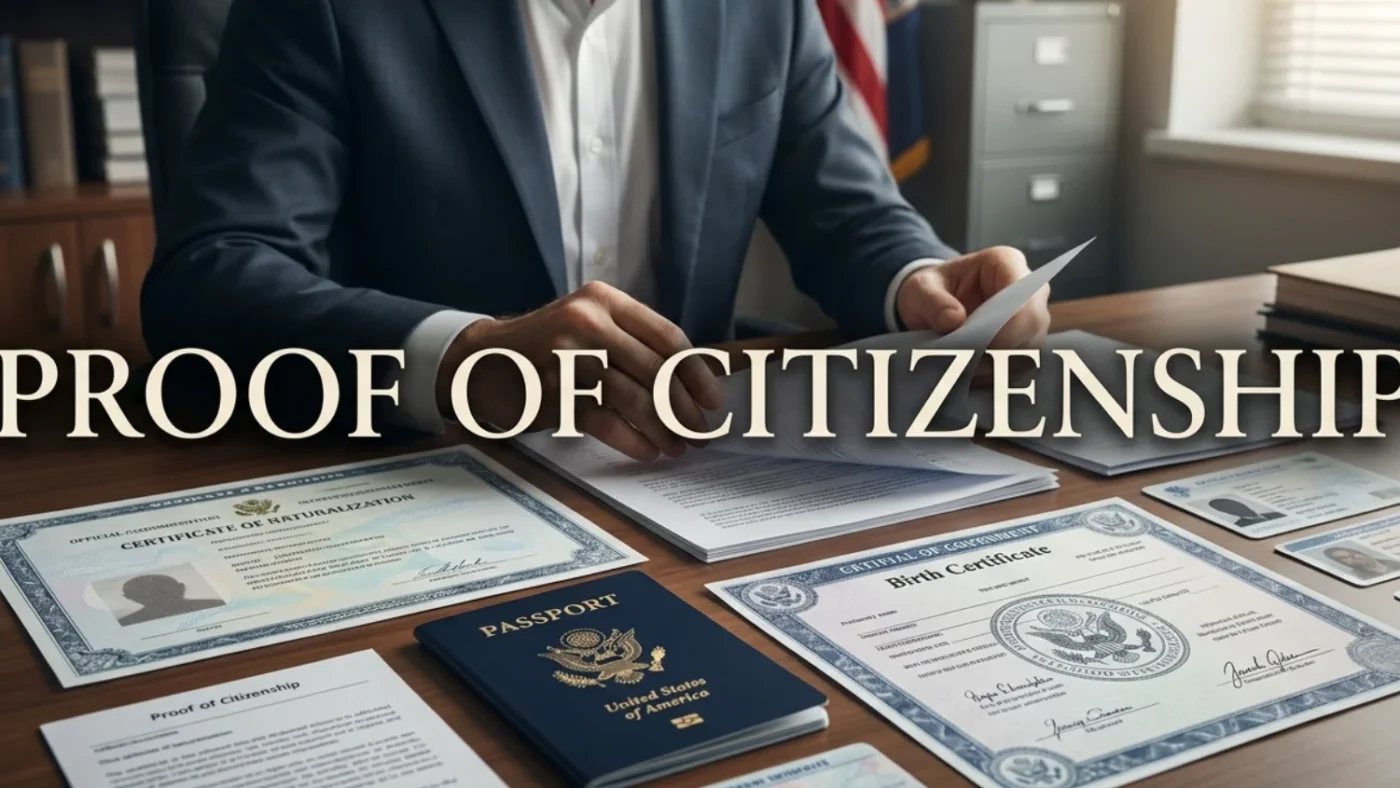
Proof of citizenship is official evidence showing that a person is legally recognized as a U.S. citizen. The document you need depends on the agency, application, and reason for verification. Passport offices, Social Security offices, and employers may have different document requirements.
That distinction matters because identity, lawful status, and work authorization are separate concepts. A driver’s license can prove identity without proving U.S. citizenship. A Social Security card can support employment verification without serving as general evidence of citizen status.
Direct answer: Common proof-of-citizenship documents include a qualifying U.S. birth certificate, U.S. passport, Certificate of Naturalization, Certificate of Citizenship, or Consular Report of Birth Abroad. The exact choice depends on the agency and purpose. Always check the receiving agency’s current list before sending original records.
| Document | What it commonly shows | Key caution |
|---|---|---|
| Certified U.S. birth certificate | Birth in the United States | It must come from the proper vital records authority. |
| U.S. passport or passport card | Identity and U.S. citizen status | Rules for expired passports vary by program. |
| Certificate of Naturalization | Status gained through naturalization | Protect the original and use USCIS replacement procedures if needed. |
| Certificate of Citizenship | Status acquired or derived through qualifying family circumstances | USCIS issues this document under federal rules. |
| Consular Report of Birth Abroad | Qualifying status acquired at birth abroad | It applies only when you meet the legal requirements. |
Key Takeaways
- Five core records appear repeatedly across federal guidance.
- The receiving agency decides which record is acceptable for its process.
- A driver’s license, REAL ID, or Social Security card may prove something different.
- Missing primary records can sometimes be replaced or supported with secondary evidence.
- People born abroad may need records showing a qualifying relationship to a U.S. citizen parent.
- Original or certified documents are often required, so photocopy rules matter.
What Counts as Proof of Citizenship in the United States?
No universal document list applies to every federal, state, or private process. The receiving agency decides which records satisfy its rules. A document accepted for one application may not work for another.
When an agency asks for proof of citizenship, start with its written instructions instead of a general checklist. Federal guidance repeatedly recognizes passports, government-issued status certificates, and qualifying birth records. The exact submission format can still change by program.
The 5 Main U.S. Documents That Can Establish Citizen Status
Five records appear repeatedly in federal instructions for proving U.S. citizenship. Each record comes from a government authority and has its own eligibility rules. The right choice often depends on where the person was born.
1. Certified U.S. Birth Certificate
A certified birth certificate is the standard starting point for many U.S.-born citizens. For passport use, federal rules require specific data, an official seal or stamp, and registrar information. A hospital souvenir certificate does not replace the government-issued vital record.
2. U.S. Passport or Passport Card
A U.S. passport or passport card can establish both identity and citizenship status in many settings. The passport card is REAL ID compliant, but you can’t use it for international air travel. Acceptance of an expired passport varies, so check the program’s current rules.
3. Certificate of Naturalization
People who become citizens through naturalization receive a Certificate of Naturalization. USCIS uses Form N-565 to replace a lost, stolen, destroyed, or damaged certificate. A qualifying legal name change can also support a replacement request under USCIS rules.
4. Certificate of Citizenship
A Certificate of Citizenship documents status for certain people who acquired it or derived it through a U.S. citizen parent. USAGov directs eligible people born abroad toward Form N-600 when that route applies. Eligibility can depend on family history, residence, birth date, and controlling law.
5. Consular Report of Birth Abroad
A Consular Report of Birth Abroad, or Form FS-240, documents certain qualifying births outside the United States. The State Department issues the record before age 18, once legal requirements are met. People without one may need a passport or another federal certificate route.
What Usually Does Not Prove U.S. Citizen Status?
Common identification documents can look official without proving that the holder is a U.S. citizen. A standard driver’s license usually establishes identity and driving privileges, not nationality. REAL ID is also an identification standard, not a general citizen-status certificate.
A Social Security card does not state whether the holder is a U.S. citizen. A Green Card proves lawful permanent residence, which is a noncitizen immigration status. An employment authorization document proves work permission, not citizen status.
- Standard driver’s license or state ID.
- REAL ID-compliant driver’s license.
- Social Security card by itself.
- Permanent Resident Card, commonly called a Green Card.
- Employment Authorization Document.
The main lesson is to separate what a document proves from where you can use it. TSA accepts several IDs for domestic airport screening for citizens and noncitizens. Employment forms also accept different combinations for identity and work authorization.
Which Document Do You Need for Common Situations?
Different agencies request different evidence because they are verifying different legal facts. Passport Services checks both status and identity when processing an application. Social Security and employment systems use their own document rules.
| Situation | What the process is checking | Practical starting point |
|---|---|---|
| First-time U.S. passport | Citizenship status plus identity | Follow the State Department evidence and photo-ID lists. |
| Social Security record update | Status, identity, or both | Use the specific SSA document list for your request. |
| Form I-9 for a new job | Identity and work authorization | Present one List A document, or one List B plus one List C document. |
| Domestic airport screening | Identity | Use a TSA-accepted ID, such as a REAL ID or passport. |
| Federal or state benefit program | Program-specific eligibility | Check the agency’s current evidence rules before submitting records. |
Form I-9 is a good example of why these labels matter. It verifies identity and work authorization, not whether every employee is a citizen. Workers facing hiring problems can read MindyGest’s guide to finding an employer discrimination attorney for broader employment context.
What If Your Main Document Is Missing?
Start by identifying which agency originally issued the missing record. Birth certificates usually come from a state or territorial vital records office. Federal certificates and passport records have separate replacement procedures.
- Identify the exact record the receiving agency will accept.
- Request a certified replacement from the original issuing authority.
- Use Form N-565 when replacing an eligible naturalization or citizen certificate.
- Ask the State Department about passport or Consular Report records when relevant.
- Keep submission instructions with your records because copy requirements can differ.
Passport applicants without primary birth evidence may qualify to use secondary records under State Department rules. A delayed birth certificate, Letter of No Record, early records, or Form DS-10 may be relevant. Read MindyGest’s affidavit guide before relying on sworn statements. Sworn statements can help only when the specific agency allows them.
Do not assume a photocopy will satisfy every office. Social Security generally requires originals or copies certified by the issuing agency. Passport applications may require original or certified evidence plus a separate photocopy.
If You Were Born Outside the United States
Being born outside the United States does not automatically prevent a person from being a U.S. citizen. Some people acquire status at birth through a qualifying U.S. citizen parent. Others can derive status later after a parent naturalizes.
The required evidence depends on the legal path and the person’s history. Records may include a foreign birth record, a parent’s U.S. evidence, marriage records, residence evidence, or a federal certificate. Follow current State Department or USCIS instructions instead of assuming a family relationship is enough.
How to Avoid Document Rejections and Delays
Read the receiving agency’s checklist before ordering replacements or mailing originals. Check whether the office wants an original, certified copy, photocopy, or another specific format. Confirm that names and dates match across the records you submit.
- Use the issuing agency’s current instructions.
- Order certified records from the official custodian.
- Check whether you must copy both sides of a document.
- Do not laminate or alter an original unless the issuer allows it.
- Keep mailing receipts or tracking when sending important records.
For passport applications, the State Department’s citizenship evidence guidance says it does not accept electronic birth certificates as citizenship evidence. Social Security also rejects ordinary photocopies and notarized copies for many document requests. Those differences make agency-specific instructions more reliable than a generic document list.
Frequently Asked Questions
What counts as proof of citizenship in the U.S.?
Common records include a qualifying U.S. birth certificate, passport, Certificate of Naturalization, Certificate of Citizenship, and Consular Report of Birth Abroad. The accepted list depends on the agency and purpose. Check the official instructions for the exact application you are filing.
Is a birth certificate always enough?
A certified U.S. birth certificate often works for a person born in the United States. Passport applications require particular details and proper government issuance. A foreign birth certificate alone does not establish U.S. citizenship.
Is a Social Security card enough?
No, a Social Security card by itself does not establish that the holder is a U.S. citizen. SSA separately checks status when that information has not already been established. The card can serve other purposes, including certain employment-verification combinations.
Does a driver’s license or REAL ID prove citizen status?
Usually not, because those credentials primarily establish identity. REAL ID compliance does not itself prove U.S. citizenship. Use the document list for the program that requested evidence of citizenship.
Can an expired U.S. passport still work?
Sometimes, because different federal programs treat expired passports differently. The State Department can accept certain full-validity prior passports as evidence of citizenship. USCIS guidance can apply a different standard, so verify the rule for your specific filing.
Your Next Step
Start with the checklist from the agency asking for your documents. Match each requested fact to a record that the agency accepts. Order a certified replacement early if your main record is missing.
For broader plain-English legal explainers, browse MindyGest’s law section. If missing records raise serious nationality or immigration questions, consider speaking with a licensed immigration attorney. This article provides general information and does not replace legal advice.