
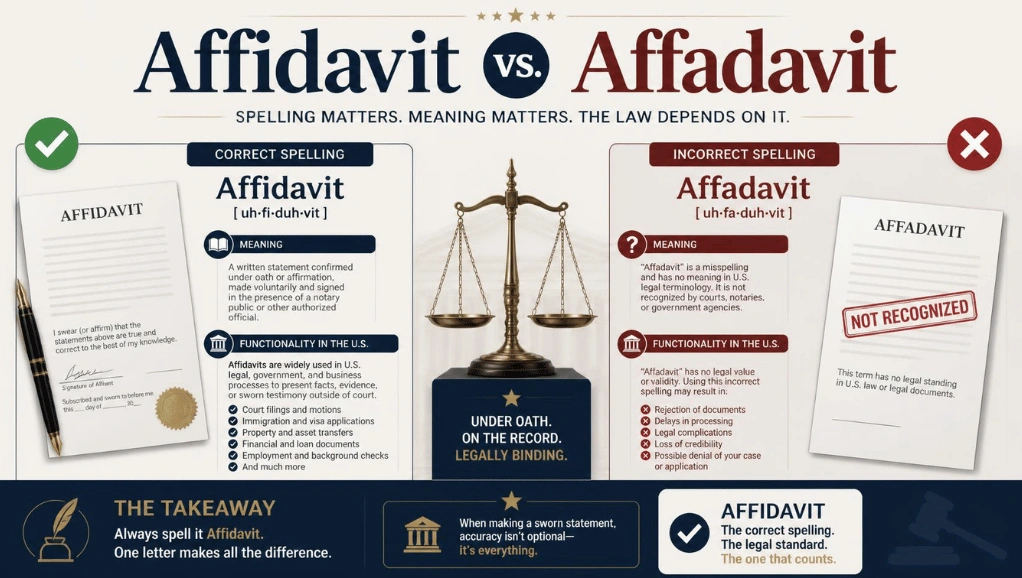
If you searched “affadavit,” the correct spelling is affidavit. In U.S. legal use, an affidavit is a written statement of facts made under oath or affirmation. The signer confirms that the information is true. A notary public or another authorized official commonly administers the oath.
Quick answer: An affidavit is a written statement of facts made under oath or affirmation. The signer, called the affiant, confirms the statement is true. A notary or another authorized officer often administers the oath. In some federal matters, an unsworn declaration under penalty of perjury can be used instead.
| Key point | What it means |
| Correct spelling | Affidavit |
| Common misspelling | Affadavit |
| Person making it | Affiant |
| Main purpose | To present sworn facts in writing |
| Oath or affirmation | Usually required for a traditional affidavit |
| Notary | Often administers the oath and witnesses execution |
| Federal alternative | An unsworn declaration may sometimes be allowed. |
| Requirements | Depend on the court, agency, state, and purpose. |
Key Takeaways
- Affidavit is the correct spelling.
- An affidavit contains facts that a person swears or affirms are true.
- The person making the statement is commonly called the affiant.
- Traditionals are often signed before a notary or another authorized official.
- The exact form can vary by state, court, agency, and legal purpose.
- Federal law allows unsworn declarations to replace affidavits in some situations.
- A false sworn statement can create serious legal consequences.
Why “Affadavit” Is Incorrect and “Affidavit” Is Correct
The standard English and legal spelling is affidavit. The version with an “a” in the middle is a common spelling error. Dictionary and spelling references consistently identify “” as the accepted form.
A simple way to remember it is to break the word into affi-da-vit. Legal forms, court rules, statutes, and government agencies use that spelling.
Correct spelling matters more with legal documents than it does in casual writing. A typo may not always invalidate a document, but using the proper term reduces confusion. It also makes forms easier for courts, attorneys, agencies, and other parties to identify.
What Is an Affidavit in U.S. Law?

An affidavit is a written declaration made under oath or affirmation before someone authorized to administer an oath. Federal regulations use this basic definition, and Cornell Law School’s Legal Information Institute describes it as a sworn statement asserting that certain facts are true.
The usually records facts that the signer knows or has a proper basis to state. Its value comes from the fact that the signer formally swears to the truth of the information.
The person who makes the statement is the affiant. You may also see terms such as declarant or deponent in related legal documents. An affidavit doesn’t automatically prove that every statement inside it is correct. It records sworn testimony in written form. A court, agency, or other decision-maker may still evaluate the statement alongside other evidence.
What Makes an Affidavit Different From a Regular Written Statement?
A normal letter can contain truthful facts, but the writer usually hasn’t taken an oath. An adds a formal promise that the information is true.
That distinction can matter in legal proceedings.
- the identity of the affiant;
- facts stated in clear paragraphs;
- an oath or affirmation;
- the affiant’s signature;
- the date of execution; and
- a certificate or section completed by the authorized official when required.
The exact format isn’t universal. Federal regulations recognize that the required form and substance can depend on the affidavit’s purpose and the law of the jurisdiction where it will be used.
That is why copying a random online template can cause problems. A court form, agency form, or state-specific requirement should take priority over a generic example.
Does an Affidavit Have to Be Notarized?
A tradition is made under oath before a person who has legal authority to administer that oath. A notary public commonly performs that function. But you shouldn’t assume every sworn statement in the United States follows the same rule.
Federal law provides an important alternative. Under 28 U.S.C. § 1746, an unsworn written declaration made under penalty of perjury can replace an oath in many federal situations. Federal court rules also recognize declarations as alternatives in specific proceedings.
The practical rule is simple: check the instructions for the specific document you are filing.
Look at:
- the court’s rules;
- the agency’s instructions;
- the official form;
- applicable state law; and
- any directions provided by an attorney or clerk.
Don’t remove a notary section because another form didn’t require one. Likewise, don’t add notarization to a declaration when the official instructions call for a different certification.
Common Uses of Affidavits in the United States
Affidavits appear in many areas of American law. Their exact role depends on the case and jurisdiction.
Court Proceedings
A party may use an objection to support or oppose a motion when procedural rules permit it. Federal Rule of Civil Procedure 56, for example, recognizes and declares in summary-judgment proceedings. It requires statements to be based on personal knowledge and admissible facts.
Written witness statements can also appear in traffic and criminal matters. MindyGest’s guide to traffic ticket lawyers and evidence discusses witness among records that may be reviewed in a driving case.
Family-Law Matters
Sworn statements can appear in parentage, custody, support, and other family-law proceedings. One state-specific example appears in MindyGest’s NC child support guide, which discusses parentage in the context of establishing parentage in North Carolina.
The form required in another state may be different, so a North Carolina document shouldn’t be treated as a nationwide template.
Estate and Property Matters
State laws may use affidavits for certain estate, probate, ownership, residency, or property matters. Requirements often depend on the state and the value or type of property involved.
Employment and injury claims
Written statements from employees, employers, or witnesses can become part of a larger evidence file. MindyGest’s work injury lawyer guide explains the importance of documenting incidents and preserving evidence in workplace claims.
Business and Administrative Matters
Businesses may encounter sworn statements during licensing, disputes, investigations, regulatory filings, or other proceedings. For broader information about business records and foundational documents, see MindyGest’s business formation lawyer guide.
What Should an Affidavit Include?
There isn’t one format that works for every U.S. legal matter. Still, many fidavits contain a similar set of elements.
1. A clear title or case caption
Court documents may require the court name, parties, case number, and document title. An agency form may already provide these fields.
2. Information identifying the Affiant
The document normally identifies the person making the sworn statement. The required details depend on the form and purpose.
3. Specific statements of fact
Facts should be organized clearly. Numbered paragraphs can make the document easier to read and reference.For certain federal court uses, the affiant must have personal knowledge of the facts and be competent to testify about them.
4. An oath or Affirmation
A traditional includes an oath or affirmation showing that the signer swears the statement is true.
5. Signature and date
The affiant signs the document according to the required procedure. If a notary must witness the signature, don’t sign beforehand unless the instructions expressly allow it.
6. Required notarial or certification language
Use the exact certificate, jurat, declaration, or other language required by the relevant form or law.
7. Referenced exhibits
If the statement refers to contracts, photographs, receipts, records, or other documents, the filing rules may require those items to be attached and labeled.
Affidavit vs. Declaration: What’s the Difference?
These documents can perform similar jobs, but their execution may differ.
| Feature | Traditional | Unsworn declaration |
| Written statement of facts | Yes. | Yes. |
| Signed by the person making it | Yes. | Yes. |
| Formal oath or affirmation | Usually | No separate oral oath |
| Notary or authorized officer | Commonly involved | Often unnecessary |
| Penalty-of-perjury language | Sworn through oath | Included in declaration |
| Can replace the other everywhere? | No | No |
| Federal use | Common | Allowed in many situations under federal law |
Under 28 U.S.C. § 1746, a properly worded declaration under penalty of perjury may replace a sworn affidavit when federal law permits that substitution.
That doesn’t mean a declaration can replace every notarized document. State law, agency rules, court orders, and specific forms can require a traditional affidavit or another method of verification.
What to Check Before You Sign
Legal forms are easier to correct before filing than after a clerk, agency, or opposing party raises a problem.
Start with the document itself.
- You have the correct form for your jurisdiction
- Names, dates, addresses, and case numbers are accurate;
- Each factual statement is truthful; and
- You can identify how you know the facts you state.
Then check the signing steps.
- Required exhibits are attached;
- The signature procedure is correct;
- notarization is completed when required; and
- You keep a copy of the final signed document.
Never sign a blank affidavit or swear to facts you know are false. Knowingly making a material false statement under oath can expose a person to perjury or other penalties, depending on the applicable law.
If a court, government agency, or opposing party provided the form, follow those instructions before relying on a general online example.
The Bottom Line
The correct legal spelling is “affidavit,” and the document is more than a signed letter. It records facts that a person formally swears or affirms are true.
Before preparing one, identify the exact court, agency, state, and purpose involved. Then use the official instructions for that proceeding.
If the affidavit could affect a lawsuit, property, immigration status, family rights, criminal liability, or a significant financial interest, consider having a licensed attorney review it before filing.
Frequently Asked Questions
The correct spelling is affidavit. It refers to a written statement made under oath or affirmation.
No. Affadavit is a common misspelling of affidavit. Legal statutes, rules, court documents, and standard dictionaries use “affidavit” as the correct spelling.
You can often prepare your own statement when a lawyer isn’t required, but the document must still meet the rules for its intended use. Courts and agencies may provide mandatory forms or specific wording.
Not necessarily. Traditional ceremonies commonly involve an oath administered by a notary or another authorized official. Some laws permit declarations under penalty of perjury instead.
Yes, when the applicable rules permit it. Its admissibility and weight depend on the proceeding, the statements it contains, and the governing evidence and procedure rules.
A knowingly false material statement made under oath can create perjury risks or other legal consequences. The exact offense and penalty depend on the law that applies.
Not always. A traditional affidavit is sworn before an authorized official. An unsworn declaration uses signed penalty-of-perjury language instead.