

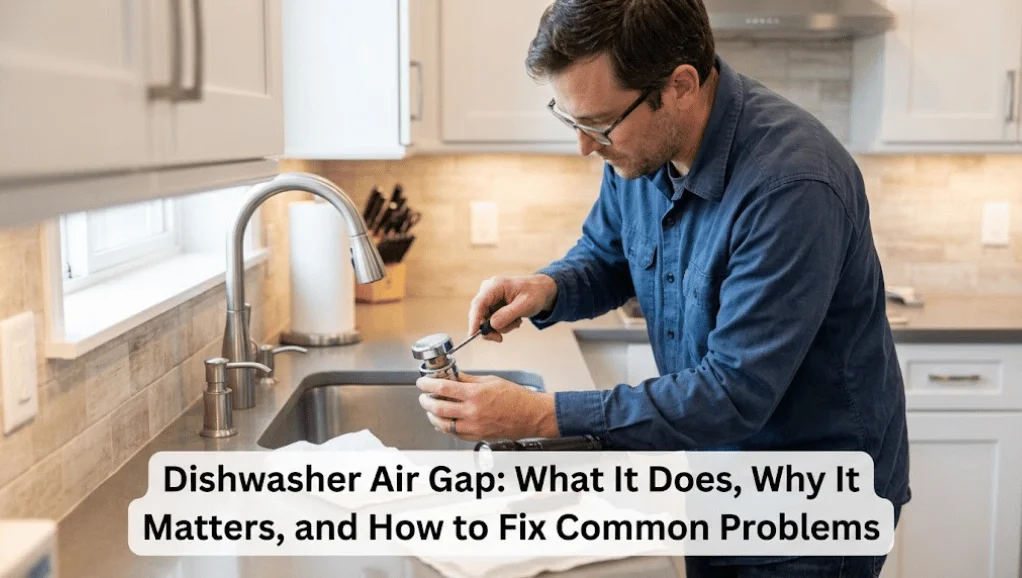
A dishwasher air gap protects your dishwasher from dirty drain water flowing backward into the appliance. It usually appears as a small capped cylinder beside the kitchen faucet. That small fitting can prevent a messy drainage problem from reaching clean dishes.
Direct answer: The countertop backflow fitting creates a physical break in the dishwasher drain path. Wastewater can leave the appliance, but backed-up sink water cannot siphon directly backward through that break. Whether you need one depends on local plumbing rules and your dishwasher’s installation instructions.
| Key point | What homeowners should know |
|---|---|
| Main purpose | Prevents drain water from flowing backward into the dishwasher |
| Typical location | Mounted above the sink or countertop near the faucet |
| Common alternative | A high loop in the dishwasher drain hose |
| Warning sign | Water spilling from the cap during a drain cycle |
| Usual cause of spilling | A blockage in the fitting, hose, disposal inlet, or downstream drain |
| Code question | Requirements vary by local code adoption and manufacturer instructions |
Key Takeaways
- The device separates the dishwasher drain from the sink drainage system.
- Local plumbing rules may require a listed countertop fitting.
- A high loop can reduce backflow risk, but it is not accepted everywhere.
- Water coming from the cap usually points to a drainage restriction.
- Cleaning the cap and checking the hoses can solve many simple clogs.
- Persistent backups, leaks, or code questions may require a licensed plumber.
What Is a Dishwasher Air Gap and How Does It Work?
A dishwasher air gap is a plumbing fitting installed between the dishwasher drain hose and the household drain connection. The fitting creates an open break instead of one continuous wastewater path. That break helps stop contaminated drain water from being siphoned backward.
During drainage, the dishwasher pump pushes used water through a hose toward the countertop fitting. Water then drops through a second hose toward the disposal or sink drain. If the downstream path is blocked, water can escape near the cap instead of returning to the appliance.
That visible overflow can look alarming, but it acts as a warning. It tells you that wastewater is meeting resistance somewhere after the fitting. The correct response is to find the restriction, not to seal the vent opening.
Do You Need One in the United States?
There is no single answer for every U.S. home because plumbing codes vary by location. Some jurisdictions require an approved countertop backflow fitting, while others permit different drain arrangements. Your dishwasher manual can also set installation requirements that apply regardless of local preferences.
The 2024 Uniform Plumbing Code requires an approved dishwasher drain fitting in Section 807.3. IAPMO explains that listed fittings must sit at or above the sink’s flood level. Local adoption can differ, so homeowners should confirm requirements with their building department.
Manufacturer guidance matters too because drain configurations vary by model. Whirlpool notes that a high loop can help prevent backflow in permitted installations. GE also advises homeowners to check the fitting whenever a dishwasher drains poorly.
For a kitchen remodel, confirm this detail before drilling new counters or ordering a sink. When required, the fitting needs an accessible location above the sink’s flood level. Planning early prevents an awkward change after countertops are finished.
Countertop Fitting vs. High Loop
Both methods aim to reduce dirty water reaching the dishwasher, but they work differently. One creates a true physical break in the drainage path. The other raises the hose to create a high point beneath the counter.
| Feature | Countertop fitting | High loop |
|---|---|---|
| Visible above counter | Yes | No |
| Creates physical break | Yes | No |
| Helps prevent backflow | Yes | Yes |
| May satisfy local code | Often where specifically required | Depends on local rules |
| Needs countertop opening | Usually | No |
| Can overflow visibly during blockage | Yes | No |
A high loop routes the drain hose upward before it connects to the sink drain or disposal. The raised section can discourage sink water from moving backward through the hose. It does not create the same open separation as the countertop device.
Do not choose between these methods based only on appearance. Check the appliance installation manual and your city or county plumbing rules. When they conflict with a preferred design, follow the required installation method.
Why Is Water Coming Out of the Countertop Cap?
Water from the cap usually means the discharge path is restricted after the fitting. Food debris, grease, mineral buildup, or a kinked hose can slow the outgoing flow. A blocked disposal inlet can create the same symptom after a new disposal installation.
A recently replaced garbage disposal deserves special attention because its dishwasher inlet starts sealed. Remove the knockout plug before connecting the drain hose. If that plug remains, discharged water has nowhere to go.
A partially clogged sink drain can also cause trouble during a wash cycle. The problem may appear only when the dishwasher pumps water faster than the drain can accept it. Repeated overflow means you need to fix the restriction before running another full cycle.
How to Clean the Fitting Safely
Cleaning is often simple when the blockage sits near the removable cap. Turn off the dishwasher before touching hoses or nearby electrical equipment. Keep towels nearby because trapped water may drain when connections move.
- Lift off the decorative cap without forcing it sideways.
- Remove the inner cover if your model has one.
- Clear visible debris with a narrow bottle brush or similar nonmetal tool.
- Rinse removable pieces and inspect the opening for buildup.
- Check the larger hose running toward the disposal or sink drain.
- Confirm that the hose is not kinked, crushed, or sharply bent.
- Reassemble the cap and run a short drain cycle while watching for leaks.
GE recommends removing accumulated material and checking the hose toward the sink drain or disposal. Avoid pushing sharp tools deep into tubing because damage can create a hidden leak. If debris is beyond reach, it may be best to leave hose disconnection to a plumber.
If your sink drains slowly at the same time, the problem may be farther downstream. Clearing only the countertop fitting will not solve a blocked trap or branch drain. Treat repeated overflow as a drainage symptom, not a defective decorative cap.
Installation Basics Homeowners Should Understand

A typical installation uses two different hose connections under the counter. The smaller connection receives discharge from the dishwasher, while the larger outlet leads toward the drain. Hose sizes and fittings can vary, so follow the instructions supplied with your hardware.
The above-counter portion must remain open to room air. Do not tape, caulk, or block its vent slots to stop water from spilling. Blocking the opening defeats the safety function and can redirect wastewater somewhere less visible.
A new sink or countertop may need a dedicated mounting hole. Before drilling stone, quartz, or solid-surface material, verify the required hole size. Professional fabrication is often safer when the countertop can chip or crack.
Kitchen upgrades often combine plumbing and finish work at the same time. MindyGest’s shiplap walls guide covers moisture-aware kitchen design ideas for surrounding surfaces. Coordinating trades before final finishes can reduce rework around the sink area.
When Should You Call a Plumber?
Call a plumber when cleaning the accessible parts does not stop repeated overflow. You should also get help when hoses leak, connections are corroded, or the sink drain remains slow. A professional can trace blockages without damaging cabinets or finished surfaces.
Code questions are another good reason to seek local advice. Requirements can vary by state, city, and adopted code edition. A licensed local plumber or building department can confirm what your installation must use.
Stop using the dishwasher if wastewater is leaking into cabinets or near electrical connections. Dry the area and shut off power if you can do so safely. Water damage usually becomes more expensive than the original drainage repair.
Related MindyGest Kitchen Reading
- MindyGest Lifestyle guides cover everyday home, kitchen, and lifestyle topics.
- The Dutch oven recipes guide offers practical cookware ideas once your kitchen is back in service.
- The one-pan meals guide focuses on simpler cooking and less cleanup for busy households.
These links are broader kitchen resources, not plumbing instructions. They can help readers planning a wider kitchen refresh or simpler cleanup routines. For drain work, rely on appliance instructions and local plumbing requirements.
Frequently Asked Questions
Does every dishwasher need a dishwasher air gap?
No, requirements vary across the United States. Some jurisdictions require a listed countertop fitting, while others accept another approved drain arrangement. Always check local rules and the dishwasher installation manual before changing the setup.
Can I replace the countertop fitting with a high loop?
Sometimes, but it depends on local code and the manufacturer’s instructions. A high loop raises the drain hose under the counter to reduce reverse flow. It should not replace a specifically required listed fitting.
Should water ever come out of the cap?
A small amount may appear when the downstream drain path is restricted. Regular spraying or spilling is not normal during proper drainage. Check for debris, a kinked hose, a disposal plug, or a clogged drain.
How often should the fitting be cleaned?
There is no universal cleaning schedule for every household. Inspect it when drainage slows, or water appears around the cap. Routine sink cleaning is also a good time to check for visible buildup.
What if my dishwasher still will not drain after cleaning it?
The blockage may be in the drain hose, disposal connection, pump, or household drain. Check simple external restrictions first without dismantling electrical components. Persistent problems deserve model-specific service or professional diagnosis.
Keep the Drain Path Working
This small plumbing part does an important job because it separates clean appliances from dirty drainage. Most problems begin with a simple restriction, but repeated overflow deserves proper investigation. Fixing the cause protects cabinets, flooring, dishes, and the dishwasher itself.
Start with the cap, visible hoses, and disposal connection, then confirm local installation rules. If drainage remains poor, contact a qualified plumber or appliance technician. Correcting the drain path is safer than hiding the symptom.