
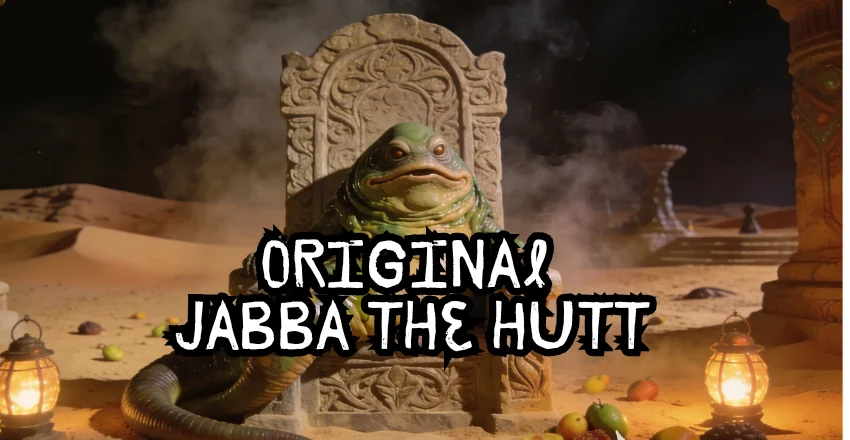
The original Jabba the Hutt looked nothing like the huge slug most Star Wars fans recognize today. A human actor portrayed the character during filming for the first Star Wars movie. That footage was removed before the movie reached theaters in 1977. Also worth reading: Omar Little Quotes.
The character later received his famous alien form in Return of the Jedi in 1983. That version used an enormous practical puppet operated by several performers. The story behind both versions explains one of Star Wars’ most unusual character transformations.
Quick answer: The first filmed Jabba was actor Declan Mulholland in a deleted 1977 Star Wars scene. The familiar slug-like version debuted theatrically in Return of the Jedi in 1983. The creature-effects team brought that version to life with a massive puppet before later editions introduced CGI.
| Key fact | Details |
|---|---|
| First actor filmed as Jabba | Declan Mulholland |
| Original movie | Star Wars |
| Original release year | 1977 |
| Was his scene released in 1977? | No |
| Famous alien version debuted | Return of the Jedi |
| Alien version release year | 1983 |
| Main technique | Large practical puppet |
| Main puppeteers | David Barclay, Toby Philpott, and Mike Edmonds |
| Later change | CGI replaced Mulholland in the 1997 Special Edition |
Key Takeaways
* Declan Mulholland performed Jabba during production of the original 1977 movie. * His Docking Bay 94 scene with Han Solo was removed before theatrical release. * The scene showed Mulholland as a large human character wearing a fur costume. * The famous slug-shaped version appeared in Return of the Jedi six years later. * The 1983 character was a complex practical puppet rather than a CGI creation. * The deleted 1977 footage returned in 1997 with a digital Jabba replacing Mulholland.
Who Was the Original Jabba the Hutt?
Declan Mulholland was the first performer filmed in the role during Star Wars production. He appeared opposite Harrison Ford in a scene involving Han Solo’s unpaid debt. The footage was shot for a confrontation near the Millennium Falcon.
Official Star Wars history confirms that Mulholland portrayed a human version of the gangster. He wore a large fur costume instead of the familiar alien design. The sequence was later removed from the theatrical release in May 1977.
This detail sometimes confuses who counts as the character’s first screen version. Mulholland was the first performer filmed for the role. However, movie audiences never saw his portrayal during the original theatrical release. Readers who enjoy this kind of film history can find more in Mindygest’s entertainment coverage.
What Did the 1977 Version Look Like?
The early version looked like a large human gangster rather than a giant space slug. Mulholland wore layered clothing, including a prominent furry outer garment. His physical presence gave Harrison Ford someone real to perform against.
George Lucas did not necessarily intend this human appearance to become the final creature design. Production accounts describe Mulholland as a stand-in for an effect that could be added later. Technical limits, cost, and story pacing kept that plan from making it into the finished 1977 movie.
That distinction matters when viewing surviving behind-the-scenes footage. The human version was filmed and performed as part of the scene. Yet the character’s visual identity was still developing during production.
Why Was the Original Scene Deleted?

The sequence repeated information audiences already learned from Greedo’s confrontation with Han Solo. Both scenes established that Han owed money to a dangerous crime boss. Removing one sequence sped up the movie.
Technical concerns also affected the scene’s future. The intended creature replacement was difficult and expensive with the effects technology available at the time. Lucas ultimately released the film without showing the crime lord directly.
The decision accidentally made the character more mysterious. Viewers heard his name and understood Han feared his retaliation. That setup gave later filmmakers room to create a much stranger physical design.
How the 1983 Puppet Changed the Character
Return of the Jedi finally showed audiences the famous alien crime lord. This version was enormous, reptilian, slug-like, and unlike Mulholland’s human appearance. It quickly became the definitive design associated with the character.
The practical creation was an unusually complicated film puppet. StarWars.com describes roughly 2,000 pounds of latex, fiberglass, wires, and other materials. Several operators had to coordinate their movements to create one convincing performance.
Phil Tippett contributed to the creature’s design development. Stuart Freeborn oversaw the British team that built the massive puppet. Sculptor John Coppinger also helped translate the design into its full-size physical form.
How Did the Jabba Puppet Work?
David Barclay was a lead performer inside the creature. He controlled key movements involving the mouth and right side. Toby Philpott worked closely beside him and handled movements including the left arm and tongue.
Mike Edmonds operated the tail from another position inside the structure. Other crew members handled features such as the eyes from outside. Every movement required close coordination among performers who couldn’t move independently.
The result behaved more like a shared acting performance than a conventional special effect. Actors on set could physically react to the creature in real time. That interaction helped the palace scenes feel grounded despite the character’s exaggerated appearance.
Human Jabba vs. the 1983 Puppet
| Feature | 1977 filmed version | 1983 theatrical version |
|---|---|---|
| Performer | Declan Mulholland | Team of puppeteers |
| Appearance | Large human figure | Giant slug-like alien |
| Movie | Star Wars | Return of the Jedi |
| Original theatrical appearance | Deleted | Included |
| Main production method | Live actor | Practical puppet |
| Famous today | Mostly among fans and historians | Yes |
| Later alteration | Replaced by CGI | Design became character standard |
The two versions represent different stages of the same evolving idea. One shows how the character existed during early production. The other established the visual identity audiences still recognize.
This evolution also reflects changes in filmmaking resources between the two productions. The first film had tighter limits and an uncertain future. By 1983, Lucasfilm could devote far greater resources to complex creature effects.
Why Did the Human Version Return in 1997?
Lucasfilm revisited the deleted Docking Bay scene for the 1997 Special Edition of A New Hope. Mulholland remained physically present in the original photography. Digital effects replaced his visible body with a computer-generated alien.
The restored scene finally showed Han and his employer talking. It also connected the 1977 footage to the design established in Return of the Jedi. Later home-video editions further revised the CGI character.
That restoration is why modern viewers may assume the alien always appeared in the first movie. The original 1977 theatrical release contained no such scene. Audiences first saw the familiar physical form six years later.
What Happened to the Original 1983 Puppet?
The enormous production puppet did not remain intact indefinitely after filming. Coppinger later recalled seeing its deteriorating remains while working at the studio. He said the materials were already breaking down.
Reports from exhibitions and surviving production material indicate that parts of the original eye mechanisms were preserved. Other production-made pieces and castings have also survived. The complete screen-used creature itself was dismantled or discarded after production.
Its disappearance makes surviving photographs, interviews, and production pieces especially useful to film historians. They document how a large practical character functioned before digital creature performances became common. They also preserve evidence of the craft behind the finished scenes.
Why the Original Design Still Matters
The character’s history offers a compact example of how movie ideas change during production. A role can begin with one physical approach and later become something completely different. Star Wars provides an unusually visible record of that process.
The transformation also shows the importance of practical performance in the original trilogy. The 1983 creature needed sculptors, builders, mechanics, puppeteers, actors, sound artists, and camera crews. Many specialists combined to create its personality.
Fans interested in similar entertainment histories can explore Mindygest’s entertainment coverage and actor profiles. The site also covers performers such as Matthew Lawrence, Jason Weaver, and Kyla Pratt. Those profiles examine how screen roles and careers develop across different periods.
Frequently Asked Questions
Was the original Jabba the Hutt a human?
Yes, the first version filmed for Star Wars used human actor Declan Mulholland. He performed the Docking Bay scene opposite Harrison Ford. His footage did not appear in the original 1977 theatrical release.
Who played Jabba first?
Declan Mulholland was the first actor filmed in the role. His performance was intended for the original Star Wars production. The character was later realized through a team-operated puppet for Return of the Jedi.
When did the slug version first appear?
The familiar alien version made its theatrical debut in Return of the Jedi in 1983. The character appeared as a massive practical puppet. That design became the foundation for later screen versions.
Was the 1983 version CGI?
No, the main 1983 version was a physical creature effect. Puppeteers worked inside and around the structure to control its movements. Digital versions appeared later in revised and prequel-era productions.
Why does the first Star Wars movie have CGI now?
The CGI comes from later revisions, not the original 1977 theatrical release. Lucasfilm restored the deleted Han Solo scene for the 1997 Special Edition. Digital effects placed an alien character over Mulholland’s original filmed performance.
Does the original puppet still exist?
The full production puppet does not survive intact. People involved in its creation describe its materials deteriorating after filming. Some production components, castings, and eye-related pieces have survived.
Final Takeaway
There are really two answers to questions about this character’s earliest version. Declan Mulholland was the first person filmed in the role during production of the 1977 movie. The public never saw his human portrayal in theaters at the time.
The version that created the character’s famous appearance arrived in 1983. A large practical puppet and coordinated performance team brought that alien gangster to life. Later CGI changed individual scenes, but the 1983 design established the visual identity fans remember.
For more film, television, and celebrity features, readers can continue through Mindygest’s entertainment section. Related actor profiles provide more background on notable performers and memorable screen roles. These pages can help readers explore entertainment history beyond a single franchise.