

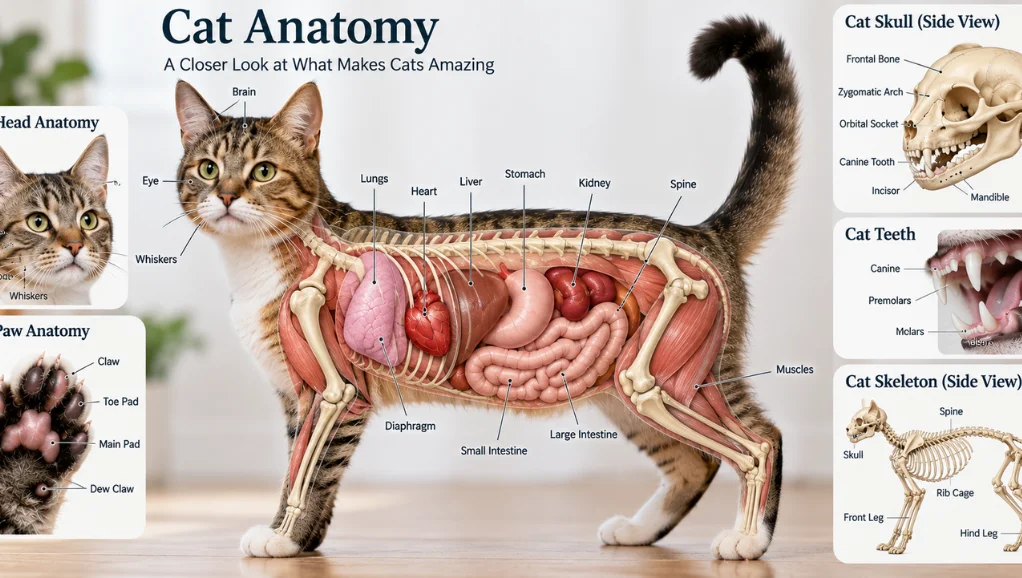
Understanding cat anatomy makes many familiar feline behaviors easier to explain, from twisting during a jump to detecting movement with whiskers. A feline body combines a flexible skeleton, powerful muscles, specialized senses, sharp teeth, sensitive paws, and compact internal organs. Knowing where these structures are and what they do can also help owners notice changes that deserve veterinary attention. You might also like Nunc Pro Tunc.
Direct answer: A feline’s body includes the skeletal, muscular, nervous, cardiovascular, respiratory, digestive, urinary, reproductive, endocrine, and integumentary systems. Its flexible spine, specialized teeth, protractile claws, sensitive whiskers, sharp hearing, and low-light vision reflect the physical traits of a small predator built to climb, stalk, jump, and maintain balance.
Cat Anatomy at a Glance
| Cat Anatomy | What to know |
|---|---|
| Skeleton | Adults have roughly 230 or more bones, with the total varying partly because of tail length and extra digits. |
| Teeth | Adults normally have 30 permanent teeth; kittens begin with 26 deciduous teeth. |
| Spine | A mobile vertebral column supports twisting, stretching, running, and jumping. |
| Paws | Most have five toes on each front paw and four on each rear paw. |
| Claws | Usually 18 claws, which stay protected when not extended |
| Whiskers | Specialized sensory hairs help detect nearby objects and air movement. |
| Ears | The outer, middle, and inner ear support hearing and balance |
| Major organs | The chest contains the heart and lungs; much of the digestive and urinary anatomy lies in the abdomen. |
Published bone totals vary across general veterinary references. Some describe about 230 bones, while others give totals closer to 250 because tail vertebrae, breed differences, and extra toes affect the count. The useful takeaway is that the feline skeleton contains more small, mobile elements than a human skeleton and is adapted for flexibility rather than rigid upright support.
Key takeaways
A flexible spine and mobile shoulder region help felines stretch, turn, and land with control.
Thirty adult teeth are specialized for gripping, cutting, and processing animal-based food.
Whiskers are sensory structures, not ordinary decorative hairs.
The heart, lungs, digestive organs, kidneys, and bladder occupy predictable areas in the chest and abdomen.
Sudden changes in breathing, balance, movement, eating, or urination warrant veterinary attention.
Skeleton and Muscles: Cat Anatomy Built for Flexible Movement
The feline skeleton includes the familiar mammalian components: a skull, vertebral column, rib cage, pelvis, and four limbs. Its spine includes cervical, thoracic, lumbar, sacral, and caudal vertebrae, with the caudal section forming the tail. Flexible joints and spinal structures let the body lengthen and rotate efficiently during running, climbing, grooming, or jumping.
The shoulder region is another important adaptation because the clavicle is small and does not form the rigid bony connection seen in people. Muscles and other soft tissues support much of the forelimb, giving the shoulder considerable mobility. Skeletal muscles then produce voluntary movement, while tendons attach muscles to bone, and ligaments help stabilize joints.
Where the Major Internal Organs Are Located
The body is broadly divided into the chest, or thorax, and the abdomen behind it. The diaphragm separates these regions and plays a major part in breathing. This layout packs the cardiovascular, respiratory, digestive, urinary, and other systems into a relatively compact frame.
Heart and Lungs
The heart sits within the chest between the lungs and pumps blood through the pulmonary and systemic circulations. The lungs surround much of this central region and exchange oxygen and carbon dioxide through branching airways. The trachea carries air from the upper respiratory tract toward the bronchi and smaller passages within the lungs.
These structures explain why a change in breathing can be more significant than it first appears. Open-mouth breathing at rest, marked respiratory effort, collapse, or blue-tinged tissues can signal a medical emergency rather than normal exertion. Owners should seek veterinary care promptly when breathing becomes clearly abnormal.
Stomach, Liver, Pancreas, and Intestines
Food moves from the mouth through the esophagus and into the stomach before entering the small intestine. The liver, gallbladder, and pancreas support digestion and metabolism, while the large intestine helps process material before waste leaves the body. Washington State University’s veterinary anatomy material identifies these organs as the major components of the feline digestive system.
The liver has broader jobs beyond digestion, including processing nutrients and helping remove or modify substances carried in the blood. Cornell describes normal intestinal blood as passing through the liver before returning to systemic circulation. This link between structure and function is why liver disorders can affect several parts of the body, not just digestion.
Kidneys, Bladder, and Urinary Tract
Two kidneys filter the blood and produce urine, which travels through the ureters to the bladder. Urine then leaves through the urethra, whose anatomy differs between males and females. Male felines have a longer and narrower urethra, which contributes to their higher risk of dangerous urinary obstruction.
Repeated litter-box visits, straining, crying during urination, or producing little to no urine deserve urgent attention. Cornell identifies complete urethral obstruction as a true veterinary emergency because it can quickly disrupt kidney function and electrolyte balance. Waiting to see whether a blocked animal improves on its own can allow a life-threatening condition to progress.
Teeth, Whiskers, Eyes, and Ears
Adult felines normally have 30 permanent teeth: 12 incisors, four canines, 10 premolars, and four molars. Kittens first develop 26 deciduous teeth, which are gradually replaced as the permanent set erupts. Tooth shape reflects function, with small incisors at the front, prominent canines for gripping, and rear teeth suited to cutting and processing food.
Whiskers, technically called vibrissae, are thick sensory hairs seated in highly sensitive follicles. They occur around the muzzle and other areas, including above the eyes and on the forelegs, and help detect nearby objects and subtle environmental movement. They should not be treated like ordinary coat hair or trimmed for cosmetic reasons.
The eyes and ears add two more highly developed sensory systems. A reflective structure behind the retina called the tapetum lucidum improves visual sensitivity in dim conditions, while forward-facing eyes support depth perception. Cornell reports that feline hearing can detect frequencies up to about 60 kilohertz, and inner-ear structures also contribute to balance.
Paws, Claws, Tail, and the Primordial Pouch
Sensitive paws provide contact with the ground, help absorb impact, and give the nervous system information about surfaces and vibration. Most individuals have five digits on each front paw and four on each rear paw, although polydactyl animals have additional toes. Their curved claws remain protected much of the time and can be extended for climbing, gripping, defense, or traction.
The tail extends the spine and helps with balance during rapid movement, but it also carries social signals through its position and motion. Another normal feature is the primordial pouch, the loose flap of skin and fat along the lower abdomen near the hind legs. VCA notes that pouch size varies with genetics, breed, and age, so a visible pouch does not by itself mean an animal is overweight.
Why Knowing Normal Anatomy Helps Owners
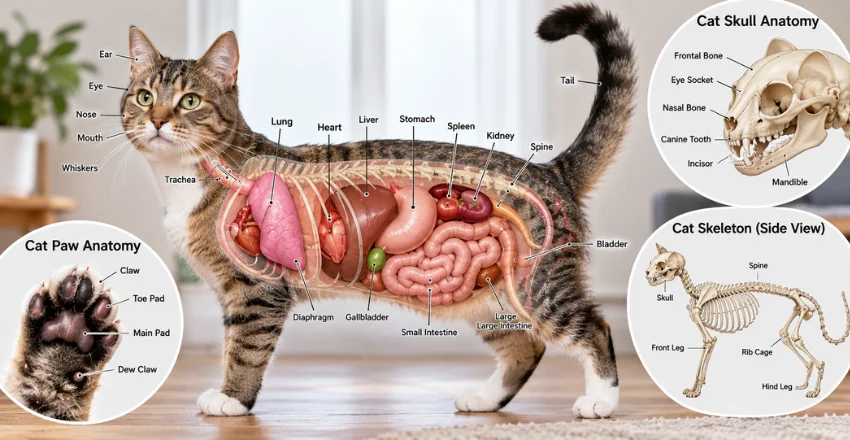
A basic body map gives you a useful baseline for noticing changes without trying to diagnose disease yourself. New limping, unexplained swelling, loss of balance, difficulty chewing, repeated vomiting, breathing changes, or urinary problems can point toward a body system that needs examination. Veterinary history, physical examination, laboratory testing, and imaging are still needed to identify the cause.
Neurologic changes are a good example because abnormal movement can arise from several unrelated conditions. Mindygest’s explainer on cats said to have Down syndrome explains why appearance or movement alone cannot establish a diagnosis and why changing signs should be assessed clinically. The same principle applies throughout the body: anatomy can tell you where a problem may be occurring, but not necessarily why.
Responsible pet ownership also depends on prevention rather than waiting for obvious illness. Routine veterinary visits, dental checks, weight monitoring, safe exercise, and attention to behavior provide useful information about physical health over time. Mindygest’s National Puppy Day guide to responsible pet ownership covers the same preventive-care principle for companion animals.
A Better Body Map Makes Better Observations
Learning the major bones, organs, senses, and external structures helps owners better understand everyday feline movement and behavior. It also makes it easier to describe a change accurately when speaking with a veterinarian. For more companion-animal and everyday living coverage, readers can browse the Mindygest Lifestyle section as the site’s pet library grows.
This guide is educational and is not a substitute for an examination or veterinary diagnosis. Sudden breathing difficulty, collapse, severe weakness, major trauma, seizures, or inability to urinate can require urgent professional care. When a physical or behavioral change concerns you, contact a veterinarian who can assess the individual animal.
Frequently Asked Questions
How many bones does a cat have?
A typical adult has roughly 230 or more bones, but no single count fits every individual. Published references differ because tail length, breed traits, and extra digits can change the total. That variation is why an approximate range is more useful than treating one number as universal.
How many teeth do adult cats have?
Healthy adults normally have 30 permanent teeth divided among incisors, canines, premolars, and molars. Kittens begin with 26 deciduous teeth before the adult set replaces them. Missing, broken, painful, or heavily discolored teeth should be assessed during a veterinary dental examination.
Why is cat anatomy so flexible?
The spine contains numerous mobile vertebrae, while the shoulder region is less rigidly attached than a human shoulder girdle. These traits let the torso extend, rotate, and compress during climbing, running, grooming, and jumping. Strong muscles around those joints provide the controlled movement people often interpret as extraordinary flexibility.
What are whiskers used for?
Vibrissae provide tactile information about objects and movement close to the body. Their sensitive follicles transmit mechanical information to the nervous system, complementing vision and hearing. Whiskers around the face and forelegs are therefore functional sensory structures, not simply longer pieces of fur.
Where are the kidneys and bladder located?
The kidneys lie in the abdomen and send urine through narrow ureters to the bladder. The bladder stores urine until it passes through the urethra during urination. Difficulty passing urine, especially in a male, can indicate an obstruction that requires immediate veterinary care.
Is a hanging belly always a sign of obesity?
No, because the primordial pouch is a normal anatomical feature along the lower abdomen. Its size differs between individuals and can become more noticeable with age, genetics, and normal body movement. VCA recommends assessing body condition by looking at features such as the waist and how easily you can feel the ribs, rather than judging weight from the pouch alone.