

Carotid sinus massage (CSM) is a simple, yet effective cardiology technique used to manage certain arrhythmias and assess autonomic function. By applying gentle pressure to the carotid sinus, a baroreceptor-rich area at the carotid artery bifurcation, vagal stimulation slows the heart rate. It can terminate AV node–dependent arrhythmias, such as SVT.
CSM also serves a diagnostic role in evaluating baroreflex sensitivity and detecting carotid sinus hypersensitivity. Understanding its mechanism, technique, indications, risks, and contraindications is essential for safe and effective use.
Carotid Sinus Massage at a Glance: Indications, Technique, and Risks
| Topic | Details |
| Definition | Gentle pressure applied to the carotid sinus massage baroreceptors, slow heart rate, and terminate AV node–dependent arrhythmias. |
| Mechanism | Pressure on carotid sinus → signals via glossopharyngeal nerve → brainstem → vagal stimulation → slows SA node & AV node conduction → may terminate reentrant arrhythmias. |
| Duration of Effect | Immediate effect within seconds; lasts seconds to a few minutes; sufficient to terminate SVT or assess baroreflex; temporary AV nodal slowing in AFib. |
| Indications | – Supraventricular tachycardia (AVNRT, AVRT) – Diagnostic carotid sinus testing for syncope or baroreflex sensitivity – Rare temporary AV nodal slowing in AFib |
| Effectiveness | Terminates AV node–dependent SVT in ~20–40% of patients on the first attempt; success increases with repeated maneuvers or Valsalva. |
| AFib Role | Does not terminate AFib; may temporarily slow the ventricular rate. |
| Location | carotid sinus massage: just below the angle of the jaw at the bifurcation of the common carotid artery; massage applied laterally, avoiding midline; check for bruits first. |
| Technique | Patient supine, neck slightly extended; palpate carotid pulse; apply firm, circular pressure for 5–10 seconds on one side; monitor ECG and BP; avoid bilateral massage simultaneously; repeat on opposite side if needed. |
| Risks & Complications | – Bradycardia or prolonged pauses – Hypotension, dizziness, syncope – Stroke (rare, if carotid atherosclerosis present) – Arrhythmia induction (rare) – Local discomfort |
| Contraindications | – Known carotid artery stenosis or bruit – Recent stroke or TIA – Severe carotid atherosclerosis – Unstable heart disease or ventricular arrhythmias – Bilateral simultaneous massage |
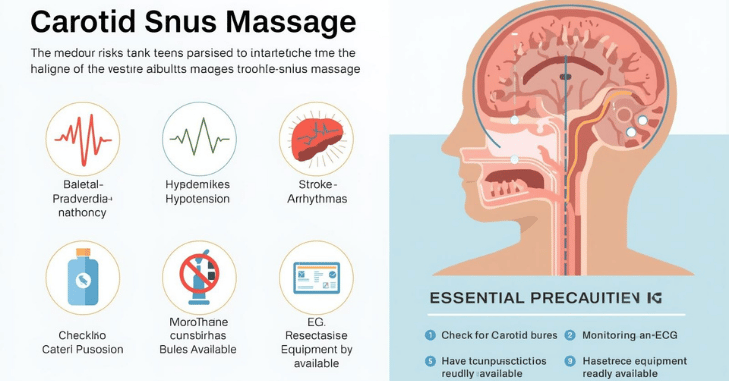
| Precautions | Continuous ECG & BP monitoring, resuscitation equipment ready, trained personnel, single-side massage first, careful patient selection. |
| Diagnostic Use | Assess baroreflex function, identify carotid sinus hypersensitivity, and explain unexplained syncope in older adults. |
What Is Carotid Sinus Massage?
The carotid sinus is a dilated area located at the bifurcation of the common carotid artery into the internal and external carotid arteries. It contains baroreceptors, specialized pressure sensors that detect changes in arterial blood pressure.
These receptors communicate with the brainstem via the glossopharyngeal nerve (cranial nerve IX) and modulate autonomic responses, particularly the vagus nerve, which can slow heart rate and reduce atrioventricular (AV) conduction.
Carotid sinus massage involves gentle, targeted pressure over the carotid sinus to stimulate these baroreceptors. The resulting vagal response can slow the heart rate and, in some cases, terminate certain types of arrhythmias, particularly supraventricular tachycardia (SVT).
Mechanism of Carotid Sinus Massage
The effectiveness of CSM is rooted in autonomic nervous system physiology:
- Baroreceptor Activation: When pressure is applied to the carotid sinus, stretch-sensitive receptors detect the mechanical force.
- Signal Transmission: These receptors send signals via the glossopharyngeal nerve to the nucleus tractus solitarius in the brainstem.
- Vagal Stimulation: The brainstem responds by activating the parasympathetic nervous system, increasing vagal tone.
- Heart Rate Reduction: Vagal stimulation slows the sinoatrial (SA) node and prolongs conduction through the atrioventricular (AV) node.
- Arrhythmia Termination: In AV node–dependent arrhythmias such as AV nodal reentrant tachycardia (AVNRT), slowed conduction can interrupt the reentrant circuit, restoring normal sinus rhythm.
In essence, carotid sinus massage leverages the body’s natural baroreflex to modulate heart rate and conduction.
How Long Does Carotid Sinus Massage Work?
Carotid sinus massage (CSM) is a temporary intervention, with its effects occurring almost immediately upon stimulation. The vagal response triggered by the massage typically lasts only a few seconds to a few minutes, which is usually sufficient to terminate a vagally responsive arrhythmia or to observe hemodynamic changes for diagnostic purposes.
The duration of its effect can vary depending on the type of arrhythmia, the patient’s individual physiology, and the strength of the vagal response. Because the effect is short-lived, CSM is often used as a first-line bedside maneuver before pharmacologic therapy or other interventions.
Indications for Carotid Sinus Massage
1. Supraventricular Tachycardia (SVT)
CSM is most commonly used in paroxysmal supraventricular tachycardia (PSVT), particularly:
- AV nodal reentrant tachycardia (AVNRT)
- AV reentrant tachycardia (AVRT)
Mechanism in SVT: The vagal stimulation slows AV node conduction, interrupting the reentrant circuit. Studies show success rates of 20–40% in terminating AV node–dependent SVT with a single attempt. Repeated or combined maneuvers (e.g., Valsalva) can increase success rates.
2. Diagnostic Use
CSM can be used as a diagnostic test to:
- Evaluate baroreflex sensitivity
- Identify carotid sinus hypersensitivity, which can explain syncope in older adults
Procedure: Heart rate and blood pressure are monitored during CSM. A pause in heart rate or a drop in blood pressure may indicate abnormal carotid sinus sensitivity.
3. Atrial Fibrillation (AFib)
- CSM is not practical for terminating atrial fibrillation, since AFib is not AV node–dependent.
- However, in some patients, vagal maneuvers, including CSM, may temporarily slow the ventricular response by increasing the AV node refractory period.
- It is rarely used in AFib management except as part of bedside assessment.
Location and Technique of Carotid Sinus Massage
Proper location and technique are critical for safety and effectiveness:
Location
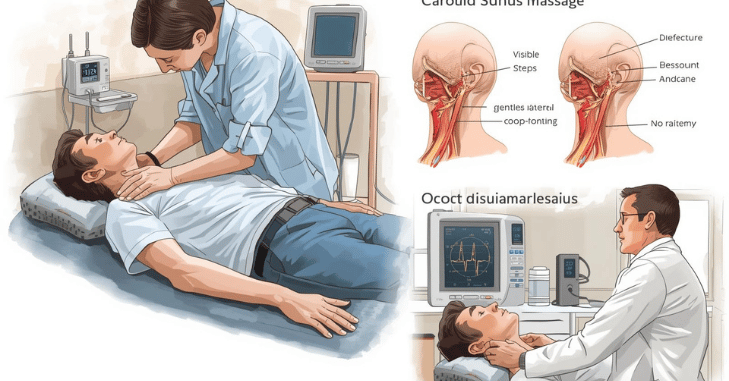
Proper location and technique are critical for the safe and effective performance of carotid sinus massage. The carotid sinus is located at the neck just below the angle of the jaw, where the common carotid artery bifurcates into the internal and external carotid arteries.
Massage should be applied laterally over the carotid sinus, avoiding the midline, and care must be taken to check for carotid bruits beforehand, as the presence of a bruit may indicate underlying stenosis and increase the risk of complications. Targeting the correct location maximizes the vagal response while minimizing potential risks.
Technique
The patient should be supine with the neck slightly extended to expose the carotid area. The healthcare provider gently palpates the carotid pulse to confirm the artery’s location. Firm, circular pressure is then applied for 5–10 seconds on one side only, while continuously monitoring ECG and blood pressure.
If no response is achieved, the message may be repeated on the other side after a brief interval. Care must be taken to avoid simultaneous bilateral massage, and resuscitation equipment should be readily available in case of bradycardia or syncope. Proper technique ensures both effectiveness and patient safety.
Risks and Complications
While CSM is generally safe, it carries potential risks:
- Bradycardia: Excessive vagal stimulation may cause prolonged pauses.
- Hypotension: A sudden drop in blood pressure may lead to dizziness or syncope.
- Stroke: Rare, but possible if a patient has carotid atherosclerosis.
- Arrhythmias: Rare induction of ventricular tachycardia or fibrillation.
- Local discomfort: Soreness or mild pain at the massage site.
Risk Mitigation: Pre-procedure assessment, continuous monitoring, and trained personnel are essential to minimize complications.
Contraindications
Carotid sinus massage is contraindicated in the following scenarios:
- History of stroke or transient ischemic attack (TIA) within the last 3 months.
- Known carotid artery stenosis or bruit.
- Severe atherosclerotic disease of the carotid arteries.
- Acute myocardial infarction with unstable hemodynamics.
- Presence of a pacemaker (as massage may induce unnecessary bradycardia).
- Aortic stenosis or other critical valvular disease that can worsen with vagal stimulation.
Proper screening is crucial to ensure patient safety.
Step-by-Step Summary of Carotid Sinus Massage
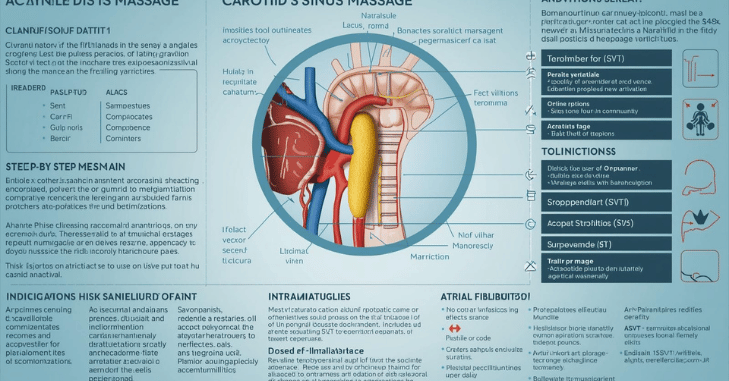
| Step | Description |
| Patient Position | Supine with neck slightly extended |
| Locate Artery | Palpate the carotid pulse just below the angle of the jaw |
| Check for Bruit | Avoid massage if a bruit is present |
| Apply Massage | Firm, circular pressure for 5–10 seconds on one side |
| Monitor | Continuous ECG and blood pressure |
| Repeat if Needed | Massage the other side after a short interval if there is no response |
| Safety | Keep resuscitation equipment nearby; do not massage both sides simultaneously |
Duration of Effect
The effects of carotid sinus stimulation occur almost immediately, with vagal stimulation slowing the heart rate within seconds. This response is typically short-lived, lasting seconds to a few minutes, which is generally sufficient to terminate supraventricular tachycardia (SVT) or assess baroreflex function.
In rare cases, the temporary slowing of the heart rate may also help diagnose arrhythmias or control the ventricular rate in patients with atrial fibrillation. However, it does not terminate AFib itself.
Clinical Evidence and Success Rates

Carotid sinus stimulation can terminate AV node–dependent supraventricular tachycardia (SVT) in approximately 20–40% of patients with a single attempt. Its effectiveness increases when repeated maneuvers are performed or when combined with other vagal techniques, such as the Valsalva maneuver.
When used for diagnostic carotid sinus testing, abnormal responses can indicate carotid sinus hypersensitivity, a condition often observed in older adults with unexplained syncope. In patients with atrial fibrillation (AFib), studies show that CSM may temporarily slow conduction through the AV node but does not terminate the arrhythmia, highlighting its limited role in AFib management.
Tips for Safe Practice
- Assess patient history for vascular disease, recent stroke, or syncope.
- Monitor vitals and ECG continuously.
- Limit pressure and duration to avoid excessive vagal response.
- Have resuscitation equipment ready in case of bradycardia or cardiac arrest.
- Educate the patient about potential transient dizziness or syncope.
Conclusion
Carotid sinus massage is a simple, effective, and generally safe technique that leverages the body’s natural baroreflex to manage certain arrhythmias, particularly AV node–dependent SVT, and to assess autonomic function. Its effects are immediate but short-lived, making it a useful first-line maneuver before pharmacologic interventions.
While it does not terminate atrial fibrillation, it can temporarily slow the ventricular response in some cases. Proper knowledge of mechanism, location, technique, and precautions is essential to maximize effectiveness and minimize risks such as bradycardia, hypotension, or rare complications like stroke.
With careful patient selection, continuous monitoring, and trained personnel, carotid sinus massage remains a valuable tool in both diagnostic and therapeutic cardiology.
Want to know about Jardiance for Heart Failure: Comprehensive Guide on Mechanism, Benefits, Dosing, Safety, and Long-Term Outcomes Check out our Fitness category.
FAQs
By directly activating the carotid baroreceptors, carotid sinus stimulation is a helpful vagal technique that can stop paroxysmal supraventricular tachycardia.
Patients with diseased carotid arteries should not have their carotid sinuses massaged due to the danger of a cerebrovascular accident.
Eight experienced brief neurological side effects that could have been caused by carotid sinus stimulation: vision disturbance, “pins and needles,” and numbness in the fingers in two cases each, leg weakness in one, and “being drunk” in one.
In 50 SVT cases in which the Valsalva maneuver failed to convert the patient, carotid sinus stimulation was performed. Seven cases resulted in conversion (14.0% success rate).